
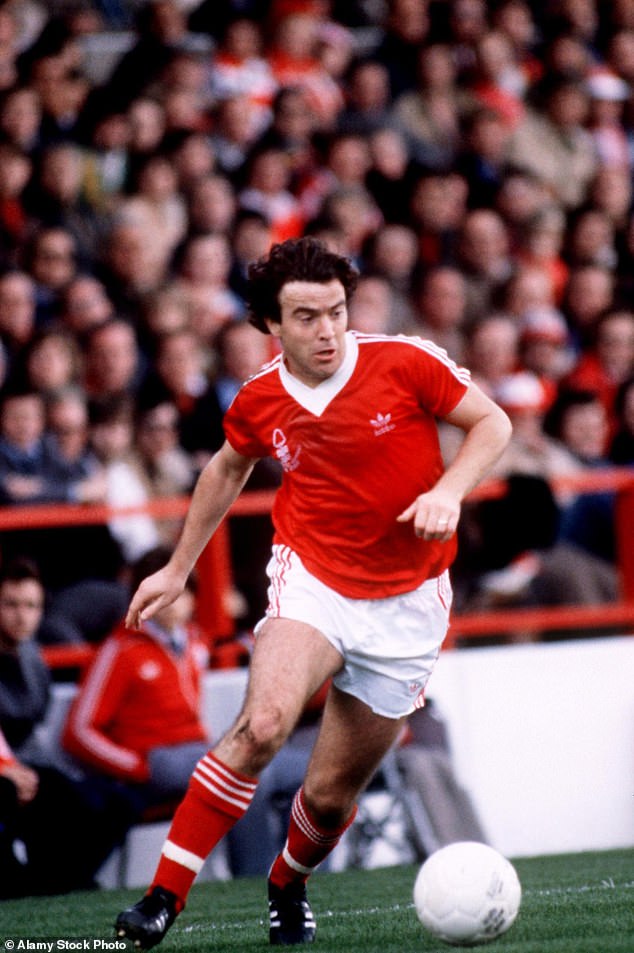
They can speak in wonder of the beaches of Rio, the barrios of Buenos Aires or the banlieues of Paris as breeding grounds for footballers but two wingers who thrilled Europe and beyond can trace their origin story to an outpost in Lanarkshire.
John Robertson, who has died aged 72, followed the twinkling footsteps of Jimmy Johnstone in transferring his tanner ba’ skills from the streets of Viewpark to the international arena.
Robertson was instrumental in delivering two European Cups for Nottingham Forest. He scored against England at Wembley. He won titles, cups and 28 caps. This is the stereotypical currency of greatness but Robbo had attributes that were strictly individual.
He was blessed with a lack of pace. This meant he had to develop and hone skills that confounded defenders. He could not just knock a ball past a defender and prosper, though he did to singular effect on one famous occasion. He was cute and sharp over five yards but his genius lay in the drop of the shoulder, the caress of that left foot, the instinctive but ultimately refined skill of unbalancing and evading the most dogged full-back.
He and Johnstone, respectively, were the best left and right wingers I have watched for Scotland. They had different styles but their capacity to inflict catastrophe on opponents was something shared, something learned on the streets, ash and grass of Viewpark.
Robertson, a wry and amiable personality, was also teak hard. He played in an era where systematic grievous bodily harm on wingers was addressed by referees with a stern talking to and where book or card were only produced if tackles threatened the very existence of the victim.
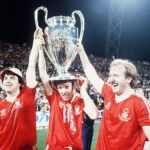
Forest hero Robertson helped deliver two European Cups

The Scotland icon (left) lifts the iconic trophy with Ian Bowyer and Kenny Burns
Robertson accepted these blows with that shrug of the shoulder that sent many a defender the wrong way. He was the most modest of men but rightfully carried a sense of his own worth. This was recognised by Brian Clough and enhanced by the great manager’s insistence that Robbo was the jewel in a shining crown.
It was appropriate that the announcement of Robertson’s death from Nottingham Forest ended with the words: “Our greatest”. His rivals for this honour include Stuart Pearce, Viv Anderson, Peter Shilton, Roy Keane, Trevor Francis and so many others. Robbo left them all in his considerable shadow.
He was taken by Clough from midfield and placed on the left wing. Oddly, he was still the playmaker. The command to give the ball to the ‘fat boy’ was insistent from both Clough and his assistant, Peter Taylor. Clough sides were marked by excellent midfielders such as Martin O’Neill, Archie Gemmill, John McGovern, Keane and Neil Webb but their primary role was to serve Robertson who, in turn, provided the chances that such as Trevor Francis, Gary Birtles and Tony Woodcock converted.
Robertson scored 95 goals in 514 appearances. This is a decent return made spectacular by the acknowledgement that one of those goals led to victory in the European Cup final against Hamburg in 1980. But it was his assist in the European Cup final of the previous season that testified to his importance to the team and to his spellbinding gifts.
Malmo had been sitting so deep there was a suspicion that many of them were wearing diving gear. An awkward ball to the left wing was instantly controlled by Robertson who was immediately faced by two defenders. His initial, unlikely burst of pace left them just in his wake but Robbo used the minimum of space to the maximum advantage. His sharp cross fell at the back post and Francis could do nothing other than head in.

Robertson (right) also enjoyed success in the dugout, working with Martin O’Neill
This was Robbo at his devastating best. His interventions were born of extraordinary skill but were rarely frivolous. Robertson was the supreme deliverer of damage.
This damage, unwittingly, extended to a severe rupture between Clough and Taylor. The latter tempted Robertson away from Forest to Derby County. It took Clough a long time to forgive his former assistant.
After 13 years at Forest — winning a second and first division title, two European Cups, a Supercup and two League Cups — his spell at Derby was underwhelming and lasted only two seasons before he returned to the City Ground for the briefest of codas. A succession of injuries had caught up with him. A professional career that had started in 1970 ended in 1986.
This had, of course, included 28 caps for Scotland. He was appreciated by Jock Stein who saw everything that Clough had in this slightly shambolic persona. Robertson scored a penalty against England at Wembley in 1981. He did this with the ease and sang-froid of a consummate performer. He also scored in a World Cup finals, chipping in from the edge of the area against New Zealand in 1982.
He then joined Martin O’Neill as his assistant as the pair worked from Wycombe through Norwich, Leicester and Celtic to Aston Villa.
He was a significant figure in all these posts but his experience and native wit came to the fore when the pair revitalised Celtic and took the club to the UEFA Cup final in Seville in 2003.

Robertson enjoyed so much success under Brian Clough at Forest though
Robertson was the buttress between team and manager. He conveyed the mood of the dressing-room and, indeed, added to it with his humour, normally delivered from the side of a mouth otherwise occupied by a fag. He also provided wise counsel to players and to O’Neill.
He had played at the highest level but he also knew what it was like to face difficulty. Before Clough, he was drifting into anonymity at Forest and he would impress players with his desire to ensure they made the most of their talents.
His life off the pitch demanded strength and resilience. He lost his brother, Hugh, and sister-in-law in a car accident just before the 1979 European Cup final. Robertson also lost a daughter to illness. A heart attack in 2013 stubbed out the smoking habit but he suffered from Parkinson’s disease in recent years.
His autobiography was titled Supertramp. This does him a disservice. Both on and off the pitch he carried the aspect of dishevelment but this was only a disguise. He was smart in both wit and action.

Robertson (right) was capped 28 times by Scotland
Robertson had that characteristic that marked his hero, Roger Federer. He could make the extremely difficult look absolutely natural. He could leave opponents gasping in a mixture of awe and physical fatigue.
The Supertramp was a sporting aristocrat. One could watch him just the once and be persuaded he was no sporting vagrant. He came from the streets but prospered on a personal catwalk situated out on the left wing.
Robertson was the product of a housing scheme that spilled genius onto its streets. He moved on geographically but he never lost what he had been given on those crude playing fields.
He played with a captivating swagger and lived with an affecting humility. He was what one wanted as a companion and as a hero. It is the neatest of tricks, all the better by being devoid of any deception.