
It’s a sharp spring morning on the east Yorkshire coast and the search for David Batty has gone cold.
After asking about him at a few cafes he’s supposed to have frequented in the seaside town of Filey, a chance conversation near the storm-weathered steel sculpture of a fisherman on the front yields a brief breakthrough. A dogwalker says he exchanged pleasantries with him some months back.
But this has not stretched to a full conversation with the man who won the top flight with Leeds United and Blackburn Rovers in the 1990s.
‘He was friendly enough, pleasant enough, passed the time of day,’ says Mike Alston, the dog walker, with his Airedale terrier, and he can’t recall anything more significant. ‘I think he lived here for a while but I heard he moved to Malton.’
In that elegant market town, 20 miles inland, signs of Batty prove equally elusive. He ‘would pass the time of day’ was ‘cheerful’ but ‘we didn’t often see him’ locals relate in the local village of Settrington, on Malton’s fringes, where he’s thought to have lived. They say he was seen in neighbouring Hovingham. People speak in the past tense. He seems to have moved on again.
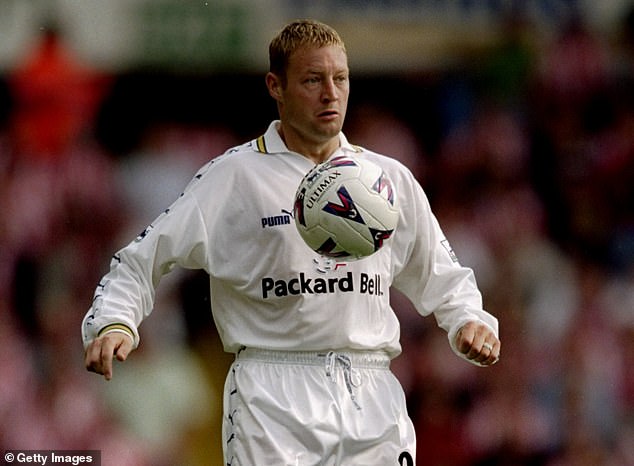
The David Batty enigma – how one of the outstanding players of the early Premiership era, and a 42-cap England international has managed to vanish off the radar since retiring in 2004 – has become as enduring a story as the player himself.
David Batty made over 300 appearances for Leeds United and was one of the outstanding players of the early Premiership era

Batty’s last public appearance was in 2011, when he laid a wreath at Elland Road in 2011 with Gary McAllister and Gordon Strachan in memory of former team-mate Gary Speed
His former Leeds team-mate Rio Ferdinand put a call out to the now 57-year-old on one of his social media channels a few months back urging one of the great characters of that dressing room to get in touch, though there’s been no response – because this is how Batty wants things to be. WhatsApp groups? Forget it.
Daily Mail Sport‘s search for Batty leads us to understand that he realises his ‘disappearance’ is a story in its own right now, and that he is highly averse to the fuss that would accompany a first public appearance since laying a wreath to his great friend and team-mate Gary Speed at Elland Road 15 years ago.
Batty supports a number of children’s charities – anonymously – but when fundraisers asked him to sign 25 footballs for an event, it was suggested they dispatch a single ball to his house, to prevent him having to visit an organisation or have them arriving at his door. He doesn’t want that spotlight.
The scarcity value of items signed by him is now substantial and those handling requests for his signature are increasingly aware of potentially disingenuous attempts to make money out of his elusiveness.
‘We have more requests for him than for anyone else we represent,’ says Hayden Evans, Batty’s agent from his playing career, whose business represents Tottenham and former Leeds man Archie Gray, among others.
The various extravagant theories which have taken hold amid Batty’s enduring absence – that he has been living in a caravan in Filey, has taken up a motorcycle racing career under a false name and was working as a butcher or slaughterman – demonstrate how easily fiction morphs into supposed fact.
Batty and his wife Mandy, who have moved around Yorkshire several times in the past few decades, did buy a house in Filey – and Malton – though as one source puts it, ‘Batts would never ask Mandy to live in a caravan’.
Batty has always been far more fascinated with motorcycle racing than football and some who have known him best still remember him meeting Carl Fogarty when a player at Blackburn Rovers – the world champion racer’s beloved team. ‘Each was the other’s hero,’ says one witness to the meeting. ‘Their jaws dropped when they met each other and neither knew what to say.’

Batty (back row, second right) with the Leeds team that won the title in 1992

Batty also won the title with Blackburn Rovers in 1994-95, although due to a broken foot his contribution was minimal – just five appearances – and he gave back his winner’s medal
But Batty has never raced bikes, despite briefly owning a twin-cylinder Asprilla 1000cc during his second Leeds spell. The ‘butcher’ myth is understood to stem from one of his twin sons briefly working as a slaughterman.
It is understood that the twins, Jack and George, are not football nuts and that you would barely know Batty was a household name, given the utter absence of football memorabilia in the family home. His No 4 shirts and medals were handed over, as they were accumulated, to his father – former Leeds Corporation binman Al – and his mother Mary, who took on various jobs, including cleaning, to make ends meet as Batty and his elder brother John were growing up.
The lack of inclination to pass on the football torch is hardly surprising, given the nature of Batty’s football upbringing. He was closely and often harshly overseen by his father, who logged his progress in countless red, hardback exercise books which charted his career. However well Batty seemed to do as a young player, his father would always find room for criticism.
Batty Snr did negotiate his son a good first contract at Leeds, but the unremitting negativity finally reaped a whirlwind one day at Stoke in January 1990 when, seeing his father demanding more from him in the stands, the then 21-year-old saw red and proceeded to deliberately concede a penalty, before making a gesture of defiance at him.
‘I don’t know if the years of toil and a perceived lack of appreciation had created some sort of pressure point in my head but I decided to give him something to get really worked up about,’ Batty wrote in his autobiography. ‘It was red mist thing that I was unable to resist.’ Leeds’ Mervyn Day saved the penalty.
Batty Snr would put his son through 7km runs around the Leeds ring road, awaiting his return with stopwatch in hand, and stage training sessions for him ahead of pre-season. Batty, determined to compensate for his modest build which saw him stand 5ft 4in when he signed schoolboy terms for Leeds as 16-year-old, willingly accepted.
But there seems little doubt that the regime, supplemented by the arch discipline of Leeds’ schoolmasterly title-winning manager Howard Wilkinson and his sergeant major Mick Hennigan, beat some of the love out of the game from Batty. ‘His father could be a difficult man,’ says one source.
Batty hated training, famously and studiously avoiding it, but was always one of the hardest runners when matchday came. He ran through walls for Leeds.

Batty hated training, famously and studiously avoiding it, but was always one of the hardest runners when matchday came. He ran through walls for Leeds

Being mobbed by Gary Speed, Gary McAllister and Mel Sterling after scoring his first home goal for Leeds in 1991
It was the camaraderie and friendships of football – racing his Morris Marina against Speed, in his Ford Orion, around the Leeds inner ring road; fetching cigarettes for Billy Bremner, his first manager, who adored him; participating in endless wind-ups at Blackburn – which he loved. Speed and Vinnie Jones were his two great allies at Leeds.
But even Batty’s great successes brought something to brood on. The title he won with Leeds in 1992 was coloured, for him, by the club’s poor defence of it, finishing 17th the following year. Despite the euphoria, he always felt they’d won it too early. ‘I can’t hide from the fact that we couldn’t carry the mantle of champions with distinction,’ he wrote in his autobiography.
He gave back the title medal he won with Blackburn because he made only five league appearances due to a broken foot and felt he was not worthy of it.
Batty always eschewed and disliked the celebrity lifestyle and indulgence in football – insisting on driving modest cars to the point that Kenny Dalglish, his manager at Blackburn Rovers, felt he was mocking the club by parking up in a Ford Fiesta. His mission was always to earn enough money to be able to ‘sever all connections’, as he once put it.
Seeing through the superficiality in the game, he was unsentimental about pursuing opportunities for an improved salary to put away in his Leeds and Holbeck Building Society savings account, covertly agreeing to meet Blackburn and Juventus during the Leeds title-winning season.
There were many times when he couldn’t see what all the fuss was about in football. Evans remembers the FA asking him to provide ‘emotional support’ for 29-year-old Batty in the ‘players’ compound’ at Saint-Etienne’s Stade Geoffroy-Guichard after he missed a penalty in the shootout which saw England eliminated from the 1998 World Cup by Argentina.
‘Alright Hayden, what are you doing here?’ Batty said when he saw him. ‘Because you missed a penalty!’ Evans replied.
‘The only time he became emotional about that penalty was when Pizza Hut asked him to appear in a TV ad referencing it, after we got home,’ Evans says. ‘He was furious about them thinking he’d make money out of England fans’ misery.’

Batty missed the crucial penalty for England in an agonising shootout against Argentina at the World Cup in France in 1998

‘The only time he became emotional about that penalty was when Pizza Hut asked him to be in a TV ad. He was furious about them thinking he’d make money out of England fans’ misery’
Batty counted the pennies, only ever owned one car, and was a keen investor in a portfolio of stocks and shares. It was his last big contract, which brought him back to David O’Leary’s Leeds, which set him up for his long retirement. ‘He walked away, just as he always said he’d do. He’s been as good as his word,’ Evans says.
His team-mates knew that if any player vanished into thin air, then it would be Batty. Goalkeeper Nigel Martyn, who roomed with him for a while, tells Daily Mail Sport: ‘He once said to me, “I’m your room-mate but I’ll never be one of your friends. Once I finish football, none of you will ever see me again”.’
Batty will occasionally ring Gary McAllister around Christmas but his absence makes him a topic of conversation. ‘For someone who we’ve never seen since, he’s a topic of a lot of conversations,’ says Jon Newsome, another who played alongside him at Leeds. He certainly wasn’t a sophisticate. For years he didn’t own a chequebook or credit card and considered himself a ‘modern-world misfit’.
But his life after football does not seem to have lacked stimulation. It is understood that he will watch Leeds United if they are on TV. It is his motorcycle racing passion which he’s pursued most avidly – sometimes heading off to Isle of Man TT with friends, it is thought, for a few days under canvas, mirroring family trips of his childhood.
At a book shop signing before he disappeared from view, Batty was given the chance to take away any title he chose. He selected a motorcycle book, not football. He’s also read a lot of true-crime books – another source of fascination.
There is evidence that a curiosity with what makes sportsmen tick has never left him. Evans has represented boxer Josh Warrington and introduced Batty to him in 2017, at the Oulton Hall hotel on the outskirts of Leeds. It was a year out from the fighter’s successful title bout at Elland Road. Batty was fascinated by what motivated Warrington and is said to have loved the encounter.
Though combustible at times, those who have known him say that the characterisation of him as a firebrand is wrong.
Batty is famously remembered for his clash with Blackburn Rovers team-mate Graham Le Saux during the club’s Champions League match away to Spartak Moscow in 1995, though it was the supposedly more cultured Le Saux who was the aggressor, punching Batty below his left eye after they collided near the touchline.

Batty tests out Donington at the British Motorcycle Grand Prix in 2001

Batty left Blackburn, with whom he had become disenchanted, for Newcastle United in 1998
Batty never knew why – perhaps another team-mate’s relentless taunting of educated Le Saux, he suspected – and felt aggrieved when Rovers fined him two weeks wages, the same penalty as Le Saux. That was later reduced to one week’s salary, after Batty protested, but the episode contributed to a disenchantment with Blackburn, whom he left for Newcastle in 1998.
He didn’t move from the family home at Boston Spa, near Wetherby, and has never lived outside of Yorkshire. He is not in hiding, as one local’s encounter with him in Malton revealed. ‘I thought, “I know that voice” and when I turned around it’s Batts. I introduced him to my wife and he had time to chat.’
But this is as integrated as Batty evidently intends to be. He is understood to have now moved to a place ‘between Leeds and York’, though that could be Tadcaster, Aberford or myriad rural villages off the M1.
‘When someone stops playing, the end of the regime they have known all their football life can be a huge and difficult issue,’ says Evans. ’They struggle with the aftermath. Batts has been the exact opposite. There’s a lesson for others in that.’