

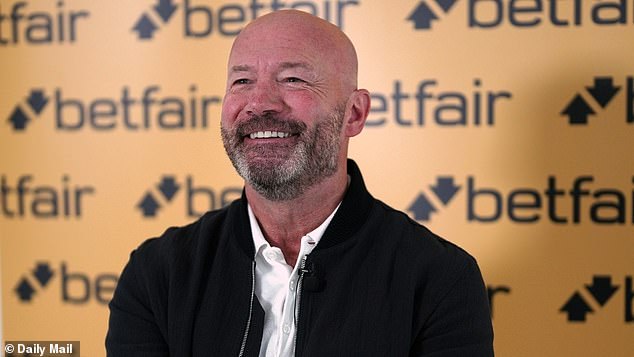
The first thing Alan Shearer did when we met in a modest studio in north-west London last week was set alight England’s biggest World Cup debate.
With Thomas Tuchel’s 26-man squad heading for Miami today, discussion has quickly shifted from who made the cut to who should start when England begin their 2026 campaign, against Croatia on June 17. And Shearer has one particularly eye-catching view.
That Jude Bellingham should not start. Instead of the Real Madrid icon, former England captain Shearer would give that position to Morgan Rogers. His argument is less about Bellingham and more about balance, partnerships and current form.
Speaking at the launch of Betfair’s World Cup campaign ‘Everyone’s Got An Opinion, Back Yours At Betfair’, the Newcastle United legend outlined the midfield trio he believes gives England the best platform.
‘Jude Bellingham doesn’t start the first game for me,’ he says. ‘I think Thomas will go with what has done well for him in England games: (Elliot) Anderson and (Declan) Rice (at the base of midfield), and then Morgan Rogers ahead of them. I would expect him to go with those three. That’s what I would do.’
It is a polarising view given Bellingham’s standing in the game. Few players of his age have amassed such experience or expectation, progressing from Birmingham City to Borussia Dortmund and then Real Madrid after a £115million move in 2023.
The first thing Alan Shearer did when we met in a modest studio in north-west London last week was set alight England’s biggest World Cup debate

Shearer would leave Bellingham (centre) out of England’s starting line-up against Croatia in the opening game on June 17, and start Morgan Rogers (right) instead
But England have spent years trying to fit all of their attacking talent into the same side. Tuchel appears determined to avoid that trap. His squad selection suggested a focus on profiles rather than reputations and partnerships rather than popularity.
That helps explain Rogers’ growing importance. Twelve months ago, the Aston Villa midfielder was still establishing himself in the Premier League. Now he finds himself at the centre of conversations about England’s strongest XI after a remarkable campaign.
He became a driving force behind Villa’s top-four finish and Europa League triumph, producing a goal and an assist in the final before being named Europa League Player of the Season. His return of 14 goals and 12 assists in 55 appearances has elevated him into one of England’s most exciting attacking options, and he is drawing interest from the likes of Premier League champions Arsenal this summer.
If there was one consistent theme in Shearer’s assessment of England’s best approach, it was the need to maximise Harry Kane. England’s captain is the nation’s record goalscorer and one of the most complete forwards of his generation. Yet Shearer believes England have not always created the right conditions for him to thrive in tournament football.
‘We didn’t see the best of Harry Kane in the last tournament a couple of years ago and I think to get the best out of Harry, as we’ve seen in that Bayern Munich team this season, you need players running past him and getting beyond him,’ Shearer says.
‘He is brilliant at coming deep to get the ball and then playing those passes himself, but you have to have players going beyond him, and we didn’t quite have that. If England are going to do well in this tournament, they have to get the best out of Harry.’
That observation goes some way towards explaining Rogers’ appeal. His instinct is to run beyond defenders, attack space and exploit the areas Kane creates when dropping deep. It is also why Shearer is convinced by the midfield pairing behind him.
Anderson’s status as England’s first-choice defensive midfielder represents a remarkable rise for a player whose departure from Newcastle United in 2024 was painful for supporters such as Shearer, but may ultimately have accelerated his development.

If there was one consistent theme in Shearer’s assessment of England’s best approach, it was the need to maximise Harry Kane

As painful as it was to see Elliot Anderson (centre) leave Newcastle, Shearer admits it has been a huge boost for the midfielder’s development
‘Anderson’s gone on another three or four levels since leaving Newcastle,’ Shearer says. ‘As much as it hurt, and as hard as it was when he left Newcastle, I think it’s certainly helped him feel a huge part of being really important in that team. He’s a wonderful talent and he’s only going to get better.’
Of course, every England squad announcement creates winners and losers. If Rogers and Anderson are among those building momentum, others face more uncertain prospects. Phil Foden is one of those, having been left behind along with Cole Palmer.
‘We’re in such a very, very good position in the No 10s,’ Shearer says. ‘Certainly one, maybe even two really, really talented players have to be left out. Phil Foden hasn’t been playing on a regular basis, therefore you can’t be doing well.
‘We all know the talent he has. He’s just had an off season by his own very, very high standards. He’s incredibly talented but we haven’t seen it enough this season.’
That is the reality of England’s current situation: there is no shortage of talent. The challenge lies in deciding which combinations work best together and players’ form. It is a problem most nations would envy, but England supporters know better than anyone that collecting elite players and building a tournament-winning team are not the same thing.
The so-called Golden Generation spent years wrestling with that dilemma. Perhaps that is why Shearer’s comments resonate. Not because he is questioning Bellingham’s quality. Not because he doubts England’s brightest stars. But because tournament football is often won by balance, structure and cohesion as much as individual brilliance.
Shearer knows better than most how intense the pressure of a World Cup can be, having captained England at France ’98. Reflecting on that experience, he says: ‘I was incredibly proud, one to play in a World Cup, and then two to captain England in a World Cup was really, really special. It’s something that will live with me for ever.’
England opened with a 2-0 victory over Tunisia in Marseille, where Shearer scored, before progressing to a dramatic last-16 clash with Argentina that remains one of the most memorable matches in England’s World Cup history.

Opening the scoring against Argentina in the last 16 of the 1998 World Cup from the penalty spot – but England would go on to lose the shootout

Shearer scores against the Netherlands at Euro 96 in England’s famous 4-1 victory at Wembley
‘It wasn’t so special how we ended up going out of the tournament but I did have some great memories including the first group game, scoring against Tunisia down in Marseille,’ Shearer recalls.
Against Argentina, a rapid-fire opening had England 2-1 up inside 16 minutes, after Gabriel Batistuta scored from the spot, Shearer answered with a penalty of his own and Michael Owen announced himself on the world stage with a glorious solo goal. But after Javier Zanetti equalised just before half-time, David Beckham was sent off and Sol Campbell had a goal disallowed for a foul on the goalkeeper, England crashed out on penalties.
‘I remember being under huge pressure, taking the first penalty,’ Shearer says of the shootout. ‘I honestly still can’t believe how it all unfolded. No one will ever forget Owen’s incredible goal, but then going out on penalties again, it hurt to go out of the tournament that way.’
Despite the disappointment, Shearer insists he looks back on both Euro ’96 and the 1998 World Cup without regret. ‘I wouldn’t say I have any regrets,’ he says. ‘If you come out of a major tournament saying we’ve given everything, we’ve given it all, then no one really can complain. I think certainly in 96 and in 98 we did that, and if it wasn’t for penalties, then who knows, but that’s the way it goes.’