
When did English football fans stop wanting English football clubs to win in Europe?
It doesn’t narrow it down much, but I know it has to be some time in the last 50 years because when I was a kid, growing up in Manchester and watching United and City on alternate Saturdays, I was desperate for an English team to win the European Cup.
I was only nine years old when Leeds United reached the final in 1975 and lost 2-0 to Bayern Munich. I loved that Leeds team, particularly Peter Lorimer and his cannonball shot, and I felt the now notorious injustice of the decisions that went against Don Revie’s side keenly.
Even though Liverpool were the enemy domestically, I felt the thrill of it when they won the European Cup in 1977 and Kevin Keegan ran Berti Vogts ragged and Tommy Smith scored a towering header to seal the victory. It was the same the next summer when Kenny Dalglish scored the beautifully delicate goal that retained the trophy for Liverpool against Club Bruges.
It was the same when Nottingham Forest won, too. I thought Trevor Francis was a brilliant striker when he was at Birmingham City and I was as transfixed as any unfortunate right back by the skill of John Robertson. I was mesmerised by Brian Clough’s charisma. Why wouldn’t I want Forest to win? In 1982, I was rooting for Gary Shaw and Gordon Cowans when Aston Villa lifted the trophy.
I don’t think I was hugely untypical. I might have been a bit of a football nerd but most of my friends were the same. Most of them were City or United fans. Most of them put domestic rivalries aside when another English club was up against one of the giants of European football in a final.
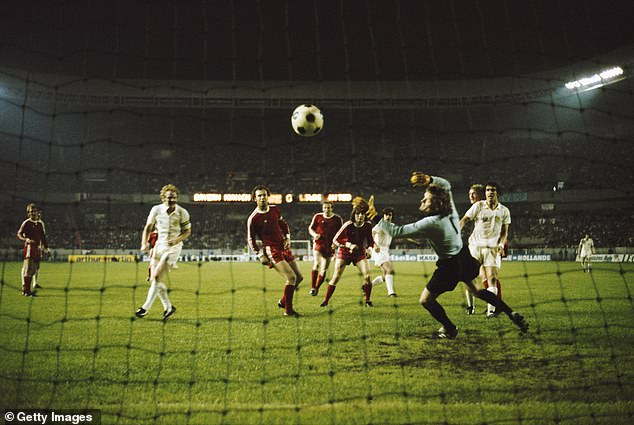
I loved that Leeds team, particularly Peter Lorimer (pictured having a goal ruled out) and his cannonball shot, and I felt the now notorious injustice of the decisions that went against them

Even though Liverpool were the enemy domestically, I felt the thrill of it when they won the European Cup in 1977 – thanks to Tommy Smith’s towering header

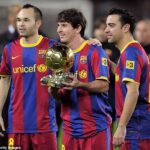
I thought Trevor Francis (right) was a brilliant striker and I was as transfixed as any unfortunate right back by the skill of John Robertson. Why wouldn’t I want Nottingham Forest to win?
That’s never left me. I wanted Manchester United to beat Bayern Munich in 1999. I had been brought up with the history of the Busby Babes and even when I had become a journalist, I was rapt by Sir Alex Ferguson’s attempt to win the trophy for the club for the first time since 1968 with a team that had former academy players at its core.
I wanted Liverpool to win in 2005 because I always had an immense amount of respect for Steven Gerrard and Jamie Carragher and I loved the city. And so it went on. I wanted Chelsea to win in 2012 and City to win in 2023. And, yes, I wanted Arsenal to win against Paris Saint-Germain in the Puskas Arena on Saturday evening in Budapest.
Which seems to leave me in a distinct minority. Arsenal’s penalty shootout defeat has been met not with regret by most English supporters outside north London but with unrestrained glee. It was the defeat that launched a million memes.
Some say it’s just because it’s Arsenal. They don’t like Mikel Arteta and they say the club is arrogant. Are they really any more arrogant than any other of the leading clubs? And then there is Arsenal’s style of play. It is said that their dearth of creativity was also responsible for making people root for PSG.
The shift in attitudes runs deeper than that. Part of it is that football fans are simply better educated in the game than they were when I was younger. I knew everything there was to know about English sides when I was growing up but I was largely ignorant of the qualities of the great club teams of the European game.
There was little exposure to those sides on British television. It was a thrill to see them when they came to play but it was more difficult for people of my generation to form an emotional attachment to a team in the way that it is common now for English kids to walk around in Real Madrid, Barcelona or Bayern Munich shirts.
They know all about the joys of Khvicha Kvaratskhelia, Vitinha and Ousmane Dembele and they might be students of PSG just as much as I enjoyed watching Leeds and Liverpool play. My attachment to European clubs began and ended with writing to Johnny Rep when he played with Saint-Etienne to ask for his autograph. I’d watched him on television playing for the Netherlands at the 1978 World Cup.
The identity of English clubs has changed beyond all recognition, too. There were three British players in the Arsenal starting lineup in Budapest. When City beat Inter Milan in Istanbul in 2023, they had two British players. When Liverpool won in 1977, 10 of their 11 starters were British. When Villa won in 1982, all 11 were British.

The identity of English clubs has changed beyond all recognition. There were three British players in the Arsenal starting line-up in Budapest – and three on the pitch at the end, too

When Aston Villa beat Bayern Munich to win the competition in 1982, all 11 players were British

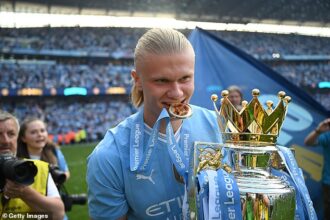
Modern fans know all about the joys of Khvicha Kvaratskhelia (centre) and they might be students of PSG just as much as I enjoyed watching Leeds and Liverpool play
I’m not saying that is better or worse, but it is different. It changes the identity of a club. Our teams are more cosmopolitan organisations now and we have been blessed with being able to watch many of the greatest players in the world every week in our league.
But the clubs’ association with a particular nation has been diluted. They are more the properties of the wider global game now than a peculiarly English entity. If you want to support English involvement in the competition outside your own club, maybe you’ll support Bayern Munich because Harry Kane plays for them.
The culture of support has changed, too. English football has always been tribal but social media has hardened those lines in the last 15 years. There is a performative tribalism at work now that glorifies hate and scorn and cruelty, and which views any wider appreciation of the game as both weak and strange.
Baiting and taunting of rivals has always been part of the game, too, but social media and fan-related stations have amplified that noise. Even mainstream sports channels harbour a grave distrust of anything that looks like impartiality.
They turn their broadcasts into offshoots of generic fan TV. They lionise bias and film their pundits running round the studio punching the air when their team scores. Everyone has to shout their affiliation out loud.
It is a strange thing: in a football age where we can see everything, the one-eyed man is king.
Be careful what you wish for, Liverpool fans

Arne Slot won as many league titles in his time as Liverpool manager as Jurgen Klopp did
Arne Slot won as many league titles in his time as Liverpool manager as Jurgen Klopp did.
He lifted the trophy at the end of his first season in the Premier League. In that season, he improved the team Klopp had bequeathed him. He dealt with the terrible loss of Diogo Jota with great dignity and compassion and helped to lead the club through the trauma.
Slot, who was sacked by Liverpool on Saturday, dealt with the injuries and the egos that assailed him last season with a stoicism that reflected well on him.
The men who run the football operation at Anfield are smart people who have made a ruthless decision but it is worth saying that history will be an awful lot kinder to Slot than the many who have been howling for his downfall.