

There are a series of unlikely stories in the history of Scottish football.
Raith Rovers being shipwrecked and then playing a friendly in Gran Canaria, Motherwell winning the Copa Del Rey and Ferenc Puskas playing his last European Cup tie at Rugby Park are jewels in this veritable crown.
But Stirling Albion being the first British side to play in Japan is an unlikely gem.
‘It is a strange story,’ concedes Jim Thomson, Albion supporter, treasurer and secretary of the club’s foundation, editor of a programme magazine and guide at the Scottish Football Museum at Hampden. He may be more precisely be described as a football geek.
He would cheerfully plead guilty to this appellation and the prime evidence would be his devotion to the tale of how Stirling Albion toured Japan 60 years ago, dropping into Athens and Tehran en route. The Binos broke new ground.
‘Japanese football was amateur but was growing,’ says Thomson, 52, a retired police officer. ‘They wanted a British team to come and help the development of the sport. Albion was the first professional team from these isles to go there.’
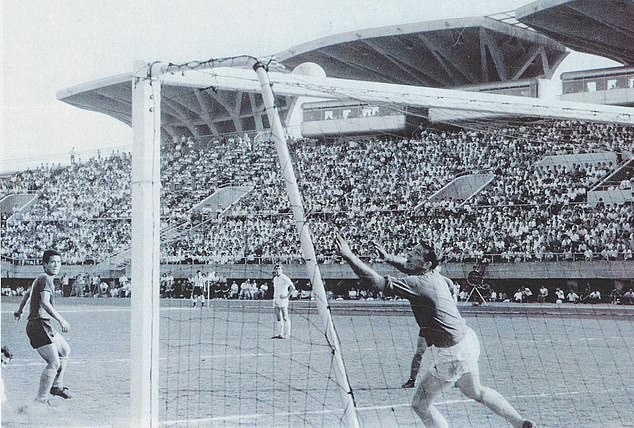
Stirling Albion’s two-game trip to Japan drew huge crowds and even bigger fanfare
But why were Albion chosen? Who did they play? How were they received? And what was it like for the players whose previous expeditions were restricted to bus trips to Dumfries or Arbroath or a summer jolly to Spain?
Thomson has most of the answers. Henry Hall, the wondrous striker who went on to play with distinction for St Johnstone, has most of the others. There is additional, invaluable contributions from an unknown English writer who cobbled his impressions together into a book but did not reveal his name.
Thus a journey into a gently mesmerising story starts with an invitation. ‘There is a bit of myth and legend about this,’ says Thomson. ‘It is believed the initial invitation was made to Sheffield Wednesday. But they turned it down after they reached the FA Cup final that year. It was felt it would be too much to take on after a demanding season.’
Albion shared travel agents with Wednesday and when the Sheffield side turned down the proposal an approach was made to the Scottish side who were then in the lower reaches of what was the premier division in Scotland.
‘That proposal seemed acceptable both to the club and the Japanese,’ says Thomson. Albion received a guarantee of £10,000-£12,000 and the host nation had a British club to boost interest in football in a country where baseball dominated.

The Scottish side were struggling in their domestic league but were thrilled to take the trip
There was also a suggestion that the letter S played a part. ‘There is a tale that suggests S is a lucky omen in Japanese culture and when Sheffield turned it down it was thought Stirling Albion would be an ideal substitute.’
The tour was an enormous success. Albion won both games against the national select in Japan and the matches were played in front of capacity crowds of 35,000 and 45,000 respectively.
‘The first match was also televised live and the club made a huge impact in the newspapers,’ he says. The team was introduced to the crown prince and advertised a beer company, receiving custom-made kimonos as a reward.
‘They were showered with gifts and literally given the red-carpet treatment,’ says Thomson. ‘In the first match, they walked onto the pitch with that red carpet under their feet. They were invited to receptions and greeted everywhere they went. They were treated like royalty.’
The games were competitive but Albion came out on top, winning 3-1 and 4-2. Hall says the Japanese were quicker and fitter than anything he had experienced before, including the Celtic and Rangers sides who were both just a year away from appearing in European finals. The forward said the Japanese were unable to deal with the Scots’ physicality. The unnamed English author also said the hosts were weak in front of goal. Anyone who ever saw Hall would know that was not one of his failings and, indeed, he scored two goals in the second match.
‘It was all before my time,’ admits Thomson as he spreads out photographs, tickets and a programme on a table in front of him.

Locals gathered to see Stirling players, who were given the red-carpet treatment by their hosts
‘I have been a collector all my life and my uncle is the unofficial club historian. The Japan trip was the holy grail for me and I have built up this collection over the years. This is my club and this is just extraordinary history. Yet few people know about it. We should be shouting about it from the rooftops.
‘These are my Lisbon Lions,’ he says pointing to the photographs of the players. ‘Palmeiras, the Brazilian side, went to Japan the next year and got beat.’
The search for more detail, more objects, continues. ‘The hunt will always go on,’ says Thomson. ‘Football is all about stories. It’s always about connections. People will come forward and say: ‘’My uncle played on that tour”. You never know what is out there.’
Henry Hall is out there, somewhere in Angus. But with memories of Athens, Tehran and Tokyo.
‘You must remember this was quite the expedition for me,’ he says. ‘We were travelling to places I never thought I would see.’
Now approaching 80, he was then just a student, studying to become a physical education teacher, and had to travel on his own as he had to wait behind to complete exams.
‘I caught up with the team in Athens and that was the most frightening night, the worst ever. The taxi driver was zooming in and out of lanes of traffic and I never thought I would make the hotel,’ he says.

The Scottish outfit brought skills and football strengths that wowed the huge crowds
Tehran, in the time of the Shah, was like nothing this boy from Airth, near Falkirk, had ever experienced before. The hotel in the city centre offered luxury but the trip to the ground gave a glimpse of reality in the Iranian capital.
‘The roads were mostly dirt-based and there were people with no arms or legs begging at the side of the road. There was poverty I had never seen.’
Tokyo was largely a delight. ‘We were treated so well,’ he says. ‘We were always greeted politely and asked for photographs.’
The diminutive Hall adds: ‘I was pointed out, probably because of my size. I suppose we were a big team. That certainly helped us against the Japanese. They were fast, fit and technically good but we were stronger, a lot more experienced. They were a bit naïve and ran out of steam in both games.’
The experience off the pitch was instructive for a young lad. ‘We would go on wee trips to religious sites and I would always find that interesting,’ he says. The manager, Sammy Baird, trained the team hard but would allow them some latitude at night as it was a tour. The only curfew was on a night before a match and on other evenings the players could go for a stroll and a beer.
‘We once wandered down a backstreet and saw immediately we were in the wrong place and exited fairly quickly,’ says Hall. But, otherwise, there were no alarms.
‘You have to realise it was 60 years ago and football was just growing in Japan and we were looked upon as something unusual.’
This was reflected in attendances and press coverage. The magisterial verdict of the unnamed English writer was: ‘The recent visit of Stirling Albion opened up a new era for soccer in Japan, for it marked the first time that a professional team had visited this country.
‘Since the end of the war we have seen a number of leading European amateur sides in Japan. But Stirling were the first professionals to come here, and I believe the Japanese players and spectators alike were impressed with the different approach to the game which they showed in relation to previous foreign touring teams.’
He adds: ‘They therefore carried a great responsibility to uphold the prestige of British football, and it is a tribute to Baird and his players that they did so, despite the fact that in Britain they are by no means considered to be a really top-class team.’

Stirling only got the invitation after Sheffield Wednesday turned down the opportunity
The players would have been pleased at the comment about their performance on and off the pitch and accepting of the verdict on their standing. Albion, after all, finished 15th of 18 in the first division.
Hall went on to play for St Johnstone in 1978, becoming one of the club’s greatest players. ‘That trip with the Albion was a great experience but I also played at the Bernabeu against Real Madrid in a friendly so that was a great memory too.’
The players returned from Japan with small transistor radios and state of the art cameras as the world of technology was booming there.
‘The only thing I remember bringing back was some Japanese cloth,’ he says. ‘I bought it in a wee shop down a side street as my mother was a great dressmaker and she did make something out of it,’ he says.
Something of Albion, too, remains in Tokyo. The Olympic Stadium boasts a small plaque celebrating the visit.
The Albion may be gone from Japan. But they are not forgotten.