
Throughout the course of 2025, as Celtic slipped and stumbled to no fewer than 17 defeats, some supporters promoted a theory that what they were witnessing was actually a deliberate act of self-sabotage by those running the club.
While this could clearly be dismissed as balderdash, it’s not difficult to see what gave rise to it. Frankly, if a board of directors was ever infiltrated by individuals who were hell bent on making a succession of ruinous decisions, they could not have achieved more.
The summer of 2024 saw the club emerge from the window having twice broken its own transfer record for Adam Idah and Arne Engels.
That November, Brendan Rodgers‘ side dismantled RB Leipzig in the Champions League, by common consent, the most authoritative display a Celtic side had produced in European football in a generation.
At the turn of that year, Celtic were well on their way to the knock-out round where they would come within a hair’s breadth of eliminating Bayern Munich.
Not only did a continuation of the club’s domestic dominance seem likely. After years of underperforming, it felt like they’d set a standard in Europe to which they would now aspire.
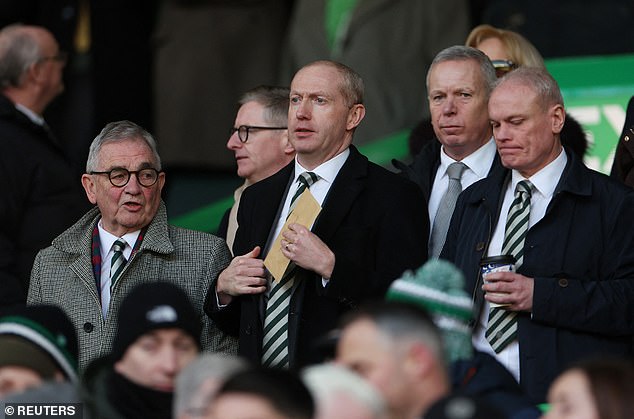
Chief executive Michael Nicholson and fellow board members attend the derby at Celtic Park

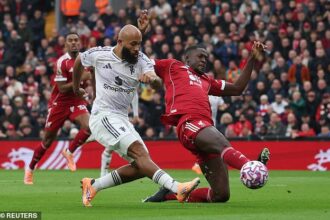
Celtic’s Alistair Johnston makes his way through protesting fans after a 3-1 defeat by Rangers

Celtic boss Wilfried Nancy’s position has become untenable after six losses in eight games
There was a certain irony in the downfall of everything beginning the very night Rodgers’ side saw off Young Boys to set up a clash with the German behemoth.
The departure of the talismanic Kyogo Furuhashi to Rennes was sanctioned without a ready-made replacement waiting in the wings.
This manifest itself in seven defeats being sustained between January and May, the last of which saw Aberdeen rip the Scottish Cup out of Celtic’s hands.
Despite having ample time to identify replacements for Kyogo and Como-bound Nicolas Kuhn in time for a play-off with Kairat Almaty worth £40m, the club singularly failed to support the football department.
Coming after Rodgers had expressly stated that no player could leave without a suitable replacement first arriving, Idah’s subsequent departure to Swansea saw the manager publicly undermined before a free agent in Kelechi Iheanacho came in and inevitably made his way to the treatment table.
An anonymous 1030-word statement issued late one Saturday evening in September blamed everyone from UEFA to the media for the club’s inability to sign football players. It only served to widen the disconnect between the board and the rank and file.
Rodgers may have erred when he let his frustrations at being denied suitable replacements come out in his infamous Honda Civic line, but no one could argue with the sentiment.
The goose of the most decorated living manager in Celtic’s history was cooked at the point when a ‘well placed club source’ told a tabloid newspaper that the Northern Irishman was working his ticket.
When Rodgers did go at the end of October – ‘resigned’ apparently – his parting gift was a vicious personal attack by Dermot Desmond, a minority shareholder, on the club’s official website.
While the team were evidently toiling in the latter days under Rodgers, Desmond’s attempt to pin the blame on him for the ongoing demise just didn’t wash. Absolutely no one bought it. Now ensconced in Saudi Arabia, Rodgers has resisted the temptation to bite back. Now, he doesn’t have to.
The return of Martin O’Neill in an interim capacity at Desmond’s behest stopped the bleeding for a while.
The veteran restored belief in the dressing room and returned the side to winning ways with seven wins chalked up in eight matches including an outstanding victory away to Feyenoord.
Having also been victorious in the League Cup semi-final against Rangers, there was every reason for the 73-year-old to take the team for the final against St Mirren, not least because it would have prevented his successor from facing a baptism of fire starting with Hearts and Roma. In keeping with their recent form, the board thought better of it.
Seemingly acting on the advice of head of football operations, Paul Tisdale, Celtic put their entire stake on Wilfried Nancy.
This was despite his Columbus Crew side finishing seventh from 15 in the MLS Eastern Conference last season.
The fact that Nancy categorically stated that he would immediately implement a 3-4-3 system mid-season also apparently threw up no red flags to the interview panel.
The Frenchman’s historically bad run of two wins in eight matches makes his position untenable, but he’s the tip of the iceberg as far as Celtic’s problems are concerned.
The culture surrounding the entire club is one of complacency, incompetence, convenience and short-cuts. There’s a deep aversion to transparency and accountability. There’s not a trace of humility.
When a new head of recruitment was needed in 2022, was Mark Lawwell, son of former chief executive Peter, really the best option? The slew of underwhelming players who arrived that summer would suggest not.
Tisdale, the self-proclaimed football doctor, arrived on the scene in October 2024 on the back of a managerial career that last took him to mighty Stevenage. Absolutely nothing on his CV suggested he was a hand-in-glove fit for the post. The reasons why he came to Celtic’s attention remain unclear. Who else was spoken to?
Michael Nicholson was the long-standing company secretary when he was appointed chief executive (after an interim spell) following Dominic McKay’s abrupt departure after 72 days in 2021. Again, there’s no suggestion that the club looked beyond its walls to fill such a vital role.
Notably absent on the day Nancy was unveiled, Nicholson has yet to answer why he believed the Frenchman was the right man for the job and what process led Celtic to his door.
Brian Wilson’s appointment as interim chairman following Lawwell’s departure also speaks to the unhealthy culture which persists at boardroom level. Wilson has been a non-executive director since 2005. Such longevity is the antithesis of good business practice.
The lack of self-awareness shown by all in the heated seats as matters have steadily gone downhill across the past year is staggering.
While a line has plainly been crossed by some individuals, the board haven’t missed an opportunity to turn their guns on the fanbase at large for having the temerity to criticise them. ‘We know better than you,’ is what’s implied.
You wonder at what point they will take ownership of the situation.
Right now, you wouldn’t put bad money on Celtic winning this title. Hearts have the bit between their teeth. Despite failing to win any of their five opening league games, Rangers are now poised to move into second place on Tuesday. Motherwell and Hibernian aren’t that far behind either.
Nancy – naive, stubborn and arrogant – is a busted flush. His team are dysfunctional and woeful. The fans have had enough to the point where there’s serious talk now of boycotts and season tickets being surrendered en masse.
And all of this at a time when the last available figures showed a jaw-dropping £77m sitting in the bank. That statistic would make losing the flag the single most embarrassing episode in the club’s proud history.
From a position of extraordinary strength, the board have hollowed out the squad and left an entire fanbase feeling disillusioned.
Little wonder the conspiracy theorists are out in force. This truth is much stranger than fiction, though.