
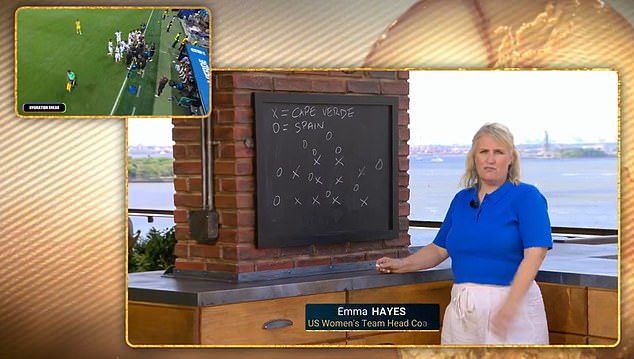
At first it appeared as though ITV had got so bored of Spain’s relentless attacks leading to nothing that they decided to have a game of noughts and crosses to pass the time.
There was Emma Hayes, standing in a corner of our screen with a black chalkboard with some white, well, noughts and crosses.
In a 70-second section, Hayes told viewers how Spain could better use their ‘wide rotations’ to break through the inspired but stubborn Cape Verde defence.
Hardly rocket science but, compared to some of the nothingness spoken around the punditry tables so far in the World Cup, Hayes made her case as the best analyst on our boxes.
At the same time, ITV demonstrated how best to use the much-maligned ‘hydration break’. On Tuesday night, the BBC commentary duo spent the three minutes simply moaning about the fact we were stopping for a sip of water.
During Argentina’s game against Algeria on Wednesday morning, the ITV duo spent the three-minute break talking about how the Wizard of Oz fits into the story of how Kansas City is not in the state of Kansas. Riveting, sure, but it did not help my mission to stay up late.
Clutching a piece of chalk and standing in front of a blackboard, Emma Hayes is educating the casual football fan one hydration break at a time

The heavily decorated manager is close to peerless in the women’s game and has bags of insight as a pundit
Yes, the break is annoying – but it’s here and it’s here to stay. By now, every argument about the hydration break’s merits – or lack thereof – has dried out.
Hayes’s cutting insight made for a pleasant interlude to the on-pitch action.
It was the same again during England’s game, where she dissected how the Three Lions were trying to beat the Croatian press. Forensic detail delivered in polished, understandable plain English for fans back in Blighty.
Half-time normally signals a cue for me to get up and do the next task on the to-do list – load the dishwasher, put the laundry away, write this article – but with Hayes in the studio, it is a must-watch education.
This is an elite-level manager at the top of her game, currently leading the United States women’s team – where they won Olympic Gold in Paris 2024 – after 12 years at Chelsea where she won seven Women’s Super League titles and five FA Cups.
Now, we do not want to get into the market of individually hammering fellow pundits. We are allowed to praise Hayes without poking fun at her contemporaries.
However, the standard of punditry, analysis and overall coverage – especially from Auntie Beeb – has fallen below the standard we have perhaps become accustomed to from the bank-account draining Sky Sports, TNT Sports and Amazon Prime.
That’s not to mention the endless list of daily World Cup podcasts that compete for our attention. Many of those, such as The England Pod and Totally Football Show, offer better analysis on the games than the two national broadcasters.

As well as being a knowledgeable talking head, Hayes makes sure not to bog viewers down with impenetrable jargon

The BBC has fallen well behind in the punditry stakes with a very mixed bag of talents involved
The BBC has many talented pundits – such as Joe Hart, Alan Shearer and a host of excellent commentators – but many others often leave one scratching the head.
They have good anecdotes to call upon but do they ever teach me anything I don’t know? Just like the failed managerial ventures of many of England’s so-called Golden Generation of the early 2000s, a legendary playing career does not automatically mean you are a solid pundit.
Both BBC and ITV have scored an own goal by not having a dedicated highlights show, too. With millions of us back home waking up, even just a 30-minute show dissecting the previous day’s action – especially the overnight games – would have been perfect.
Instead, we have been forced to turn to YouTube highlights. Adequate and a great way to start the day but a sit-down daily digest would have brought an audience, maybe even the fabled craved younger viewer.
The corporation did not even bother sending their punditry team Stateside. It is not a new opinion to say that it shows.
ITV’s coverage has been light years ahead, from their pundits to their glitzy studio (we are sometimes distracted by the noise of police sirens and the hubbub of New York City in the backdrop, but this adds to the experience, making us feel close to the action).
Hayes is the shining light and a breath of fresh air. She can break down a team’s tactics in seconds and tell us about managerial tweaks, pressing structures and weaknesses she has noticed. She does it all in a digestible manner, which is important.
There are hundreds of analysts online but, with the best will in the world, most of it is a chore to get past the second paragraph due to the style they use. Big words for the sake of it, it feels like. Hayes makes it easy to understand.
ITV’s other pundits are proving good watches, too, led by Gary Neville but also the intriguing Ange Postecoglou, knowledgeable Juan Mata and one who is not a big name but still an insightful addition is Jobi McAnuff.
After an opening week full of big teams slipping up like Spain, Brazil, Netherlands, Belgium and Portugal, it has been hard to draw conclusions on who are the nations to beat.
On our screens, though, it is clear: ITV and Emma Hayes have set the standard to follow.
Can YOU master Craig Hope’s World Cup quiz? Test your knowledge HERE