

It was almost two miles from the road end of the farm to the school. The-five-year-old, fatherless and raised by his granny, walked it each day, there and back.
‘It became three miles when we moved to another farm when I was seven but I had a bike then,’ says Neil Simpson, now 64. ‘One bad winter I was trapped by snow on the farm for two weeks.’
He adds: ‘I suppose it gives you resilience.’
Life was to give him much more. There were the spectacular baubles of footballing success – including two European medals – and the gift of children, grandchildren and eventually a father found through dogged detective work.
The story of Simpson is marked by a tackle and gilded by professional success but it also involves a childhood where money was scarce, father and mother were absent, and football was not just an obsession but, perhaps, a refuge.
He makes light of all this. ‘I had a happy childhood,’ he says. Yet he also remembers queuing for the free meal tickets at school and facing the questions about where and who his dad was.
Neil Simpson parades the Cup Winners’ Cup at Pittodrie back in 2024

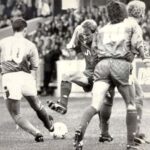
Simpson’s infamous tackle on Rangers’ midfielder Ian Durrant at Pittodrie in 1988
Later life had its traumas, too. His new-burn son was hospitalised with meningitis. He was involved in a fatal crash when a vehicle served to avoid another and hit Simpson’s car. ‘We all sat in the ambulance together and everyone seemed fine,’ he says. ‘I rang the garage the next day to get an update on my car. It was a write-off, of course. But the mechanic said he was sorry about the other chap.
‘I said: ‘’What?’’ He told me the other guy had died of internal bleeding.’
There are, of course, the bright moments in his life and those are not restricted to his spectacular success on the football field. He speaks with a smile of flying in an RAF jet and being made a cup of coffee by Zara Phillips, daughter of Princess Anne, when he visited Gordonstoun.
But, after reading his book and chatting to him in person, it is impossible to stray too far away from that boy at the road end, plunging into the wider world without a mum or dad.
‘It was not hard or soft, it was just a life,’ he says. This, one suspects, is Simpson at his most defiant, even if it is said in the gentlest of tones.
The lad raised on Aberdeenshire farms in Cluny then Newmachar was born in England. ‘I worried about that a wee bit when it became clear I was going to represent my country and play for Aberdeen in European competitions,’ he says.
This concern dissipated when he found he qualified without having to find his father. Being born in England was also no barrier.

Neil Simpson (front right) and Aberdeen celebrate their Cup Winners’ Cup win over Real Madrid
He was born in St Margaret’s Unmarried Mothers’ Hostel in London. Father not stated. His granny, Joan Thompson, came from the farm to take him and his mother back home.
‘It was a different time. When you do research, you find that babies were just handed over to people with minimum paperwork.’
Simpson stayed with his family. ‘When we went back to the farm, my uncle saw me and wondered if I was the neighbours’ child. My granny told him it was my mother’s and he was an uncle.’
This was the world of the sixties where secrets were kept and questions not asked. His father’s identity was a mystery.
‘See when you were a kid you didn’t look at any of it. Kids would say they hadn’t ever seen my dad or whatever but it didn’t bother me then. Later in life my mum married my stepdad and that is why I didn’t push to find out who was my dad. It’s a north- east thing: don’t ask these questions.’
His professional life was bolstered and heavily influenced by strong men: Alex Ferguson, Archie Knox and the irrepressible Teddy Scott, who was the heart and soul of Aberdeen in a variety of roles.
But Granny Thompson was his protector and keeper. ‘The Feein’ Market moved us from farm to farm,’ he says of the almost feudal system that held sway over farm workers. ‘She had four children. She worked hard. It wasn’t an easy life. The farm servants were down the chain.’
Life was fuelled on plates of mince and tatties and his life revolved around games of football. The matters of identity only surfaced in adulthood after his mother died. ‘That’s what started the search,’ he says of the quest to find his father. An address of the back of his birth certificate revealed where he had been born. Further investigations into DNA and ancestry led him to a man, now approaching 85, in the Borders.
They took the tests and they were positive. ‘A couple of weeks ago my father said he had been rummaging about his loft and found a programme for a England v Scotland game. He recalled what a great time he and his mates had by going to the game. I told him: ‘’I played in that match. You were watching your son without knowing it’’.’
The relationship is growing stronger. ‘It has rounded off my life,’ says Simpson.

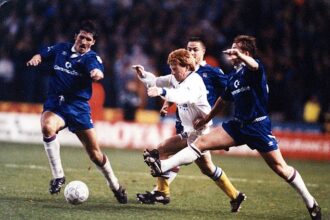
Aberdeen legend Neil Simpson battles with Celtic midfielder Paul McStay
He sits, appropriately, in the Legends lounge at Pittodrie. He spent 35 years at the club as player and coach. He now works as an executive with a metal processing company but is forever a Don. ‘Aye, I still get approached by folk remembering me as a player,’ he admits. ‘Four separate people came up to me yesterday.’
The tackle on Durrant in 1988 has marked him as a villain among Rangers fans. However, he is an enduring local hero and not just for his part in two titles, three Scottish Cups, a league cup, European Cup Winner’s Cup and European Supercup. ‘Oh and don’t forget the two Tennent’s Sixes,’ he reminds me.
Anyone who watched him play was impressed. He was technically excellent but his commitment to the cause was obvious.
‘I once played five reserve games in five days. We played twice in a day. Records show I played every moment in every game.’
His love of football found an initial outlet at Middlefield Boys’ Club where he was part of a team that won the British five-a-sides. But it never left him.

Neil Simpson celebrates Aberdeen’s Cup Winners’ Cup final win with Neale Cooper
‘You did play with injuries,’ he says. ‘I got stretchered off one Tuesday then on the Friday I was asked: ‘’How does the ankle feel? We could really do with you tomorrow’’. My ankle was strapped up in a figure of eight bandage. It was like a stookie. I played 90 minutes. The ankle swelled up, of course, and I was in the treatment room on the Monday. Fergie walked in and said: ‘What are you doing in here again?’’
All this is said with a smile with no hint of complaint. ‘It’s all about resilience, I suppose,’ he says of the imperatives of the time. He has many tales of Fergie and Knox but all bristle with respect and some are imbued with humour.
There was the occasion that Fergie threw a plate of sandwiches in the dressing room and they landed on Simpson. The ravenous farm boy simply started eating one.
‘I was brought up not to be biggsy,’ he says, using the local vernacular for arrogance. This held him back from writing his biography. ‘I thought it was only for the elite players like Willie (Miller), Alex (McLeish), Gordon (Strachan) and Jim (Leighton). They were top class. I was an integral part of the team but they were the stars.’
Simpson, of course, has a stellar history. He played in every game of the Gothenburg run, scoring in the semi-finals against Waterschei and against Bayern Munich. He also scored in the Supercup triumph over Hamburg. He competed against the best with his Michel Platini strip in the loft an emblem of those who faced up to the energetic loon.
‘I still have everything I collected over the years,’ he says. The medal won in Gothenburg is obviously the most prized but cup final tracksuits and strips have been retained.
And so have the memories. He pays homage to the friendship and guidance from Knox and Ferguson’s influence is referenced heavily. He points out that his former manager was fierce but also kind. ‘There are many stories of Fergie doing good things,’ he says.

Simpson (back middle) celebrates Aberdeen’s Super Cup win over Hamburg in 1983
The decision to write the biography had an immediate challenge. The tackle on Ian Durrant of Rangers in October 1988 had to be addressed. Durrant was taken from the field suffering from ruptured knee ligaments. He was out of the game for almost three years.
Simpson admits his regrets now, saying: ‘I am sorry for the outcome, 100 per cent. If I could turn the clock back then I wish it did not happen.’
But he points out that the rivalry with Rangers preceded the tackle. This, he says, was because Rangers were forced to confront the reality of a resurgent and dominant Aberdeen.
‘I have been in some battles with Rangers. I have seen crowds coming on the pitch, two players sent off, fights in the middle of the pitch, fights in the tunnel. Uproar. It was a powder-keg fixture.’
He believes it suited Rangers to keep alive the furore over the tackle. ‘When I received a letter from my solicitors over the negotiations I would find it was in the press a couple of days later. I felt Rangers were using it to undermine Aberdeen.’
The case hung over him for five years before an insurance payout was negotiated. He writes in the book: ‘I was angry about the way I was treated like a pariah after one tackle in a career where I made thousands of them. I’ve never forgotten it and never will.’

Sir Alex Ferguson and Archie Knox hold the Cup Winners’ Cup aloft in Gothenburg
The chapter comprises 6000 words. He does not shirk from its import, though he shrugs off the criticism that persists until this day. ’It’s water off a duck’s back,’ he says.
But there were dark times. He relates in the book that staff at a local shop were asked regularly: ‘’Where does Neil Simpson live?’’ They replied that they did not know. Police also contacted him after a Rangers fanzine published his address.
He is determined to put the controversy behind him. It will be reignited by the book but there is the belief that he has now had his say and there is a satisfaction in that.
There is also an optimism. ‘When you are in the dressing room you can be a kid as long as you want,’ he says at one point of one prank.
This spirit is not extinguished. Neil Simpson is now a grandfather but he has not strayed far from the strength and single-mindedness of the boy who trekked to school from the road end.
■ Simmy by Neil Simpson and Neil Drysdale (£25) is published by Pitch