

The only European nation to ever capture the World Cup in the Americas has travelled west with little fanfare. Germany is chastened and few are betting on Julian Nagelsmann’s team, low on star quality, hit by injuries and without the same old aura of invincibility.
Glory in Brazil was their fourth title but the seven-goal destruction of the hosts in Belo Horizonte and Mario Gotze’s winner in the Maracana are now fading memories, displaced by comical images such as goalkeeper Manuel Neuer losing possession while dribbling into South Korea’s final third as the holders crashed out in 2018.
The embarrassing early exit was the first time in 80 years they had failed to make it past the group stage, although they did no better four years later despite Hansi Flick replacing Joachim Low.
Germany for all their glittering past in this tournament have won only twice in six World Cup fixtures since Gotze toppled Argentina in extra time in Rio de Janeiro in 2014.
They beat Sweden in Russia thanks only to a brilliant 95th minute Toni Kroos free kick and fought back from behind to score three late goals and beat Costa Rica in vain in Qatar.
Losing games to Japan, Mexico and South Korea has rattled confidence. ‘I don’t think we’re a tournament team anymore,’ said Kai Havertz after elimination in 2022.
Germany’s recent tournament performances have been poor – pictured here after being dumped out of a home Euros by Spain in the quarter-finals two years ago
Gleeful Qataris waved goodbye with hands clasped over their mouths, mocking the German protests about FIFA censorship in a row about ‘One Love’ rainbow armbands which had dominated preparations.
FIFA’s Arsene Wenger stuck the boot in, too, with a sly aside during a technical analysis presentation in Doha that teams focused on competition rather than ‘political demonstrations’ had performed better.
This year, despite the wealth of material, Europe’s heavyweights have steered clear of politics.
Germany’s players have paid the inflated transport costs for 600 of their fans to travel from New York to the Met Life Stadium in New Jersey for the final group game, against Ecuador, but there has been a determined focus on football.
Changes to the format should at least prevent a hat trick of group stage exits.
One win should have any team in the reckoning for progress to the last 32 and albeit a tricky group also featuring Ivory Coast and Ecuador, Germany have an inviting start against Curacao in Houston on Sunday.
Tenth v 82nd in the FIFA rankings. Mighty four times champions and eight times finalists against World Cup rookies from a Caribbean island with a population the size of Heidelberg, bringing a fresh twist to a fierce old rivalry with the Dutch.
Dick Advocaat has returned as Curacao’s manager having quit last year to take care of family matters after holding Steve McClaren’s Jamaica to a draw in Kingston to qualify for a first World Cup.
McClaren is now head of football at Rotherham in League Two and Advocaat, in charge of his eighth different national team, is poised to become the oldest manager in World Cup history.

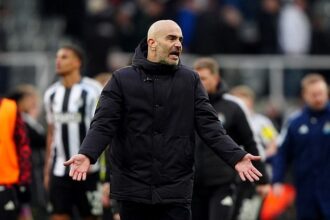
Julian Nagelsmann is attempting to bring back the aura of invincibility to the Germans
The 78-year-old was in the first of his three spells as Netherlands boss when they beat England in qualifying for USA 94 and despite ongoing tensions with star players led his team to the last eight before losing to eventual champions Brazil in Dallas.
Back in Texas, Advocaat will go up against Nagelsmann, less than half his age at 38 and charged with restoring Germany’s pride on the international stage.
Progress under Nagelsmann has been hit and miss. They underwhelmed while reaching the last eight of a home Euros and familiar problems have niggled away since, such as the lack of a natural centre forward and a vulnerable defence.
In this instance, a strong Bayern Munich does not automatically convert into a strong Germany. Bayern’s attack has relied heavily upon Harry Kane of England, Michael Olise of France and Luis Diaz of Colombia.
Even so, Germany recovered from defeat in Slovakia in the first of the qualifiers to whack six past the same opponents in the reverse fixture and finish on top of the group.
Arsenal’s Havertz is expected to lead the line and there is talent in supporting roles, although Jamal Musiala of Bayern is only just fit after missing almost the entire season through injury and Florian Wirtz has spent the same length of time in a struggle for form at Liverpool.
Perhaps this stage will help Wirtz restore his confidence and find his rhythm again. Injuries have ruled out Serge Gnabry and gifted teenager Lennart Karl, whose muscle strain in training last week led to an unexpected opportunity for 20-year-old Assan Ouedraogo of Leipzig.

In Florian Wirtz and Jamal Musiala, there’s plenty of talent, but Germany need both players to find their best form again
Ouedraogo, a product of the Schalke academy who scored within two minutes of coming off the bench for his debut in November, was on holiday with his friends, lounging by a pool in Marbella when his phone lit up with a call from Nagelsmann.
The absence of Gnabry and Karl is expected to propel Leroy Sane back into the team. Former Manchester City winger Sane is now 30 and at the end of his first season at Galatasaray.
Neuer is also back. Less than two years after retiring from international football the Bayern goalkeeper has reclaimed the status of number one keeper at the age of 40 from Oliver Baumann of Hoffenheim.
‘It wasn’t exactly cool,’ said Baumann, when asked about his sudden demotion after a 2-1 win against the USA in a warm-up friendly in Chicago.
Perhaps though, there is no better symbol of Germany’s ongoing identity crisis and the failure to kick on from the era of Kroos, Mesut Ozil and Thomas Muller than 124-cap Neuer, back in goal and preparing for a fifth World Cup.