
When the final whistle was blown on a nerve-shredding night in Foxborough, the roars of celebration could probably have been heard all the way from Boston to Bathgate.
A scrappy goal to settle a scrappy game, from a man who had been branded a ‘pub player’ only a few days earlier. As one, an entire nation raised a glass.
The Tartan Army had waited a long time for this. A first World Cup appearance in 28 years, a first World Cup victory in 36 years.
Whether they were watching in Massachusetts or Machrihanish, Scotland supporters lapped it up. There was something almost cathartic about the whole thing.
It was intoxicating. Up in the stands, supporters were dancing as if Scotland had just scored a last-minute winner in the World Cup final. Some stewards and police officers even joined in.
It was a celebration of all that’s good about football. These fans had waited a generation for a moment like this.
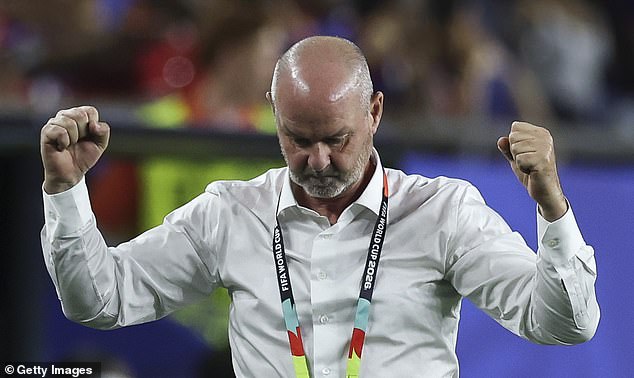
Scotland boss Steve Clarke and his players may live to regret beating Haiti by only one goal
Having spent eye-watering sums of cash to be there, nobody could take this away from them. This was a night they will remember for the rest of their lives.
Yet, when the dust settles and the hangovers ease off, a new reality will dawn. Scotland may be top of the group, but they are behind the eight-ball when it comes to qualification for the knockout stages.
This is not intended to sound like a party-pooper or to rain on anyone’s parade. It is simply a reflection of where Scotland are in the bigger picture in Group C.
Their next two opponents, Morocco and Brazil, are both ranked inside the world’s top 10. The chances of Scotland taking something from those two games? Not impossible, but a tall order.
Morocco reached the semi-finals of this tournament four years ago, beating Belgium, Spain and Portugal along the way.
They drew 1-1 with Brazil in New York on Saturday night and, especially in terms of how they played in the first half, the Moroccans look like they will be a handful once again.
Brazil need no introduction. With Carlo Ancelotti as manager and Vinicius Junior as their star man in attack, they will take some stopping.
For Scotland supporters, the arithmetic contortions have already begun. A 1-0 victory over the lowest-ranked team in the group could well be a result which they will live to regret in the fullness of time.

John McGinn’s deflected winner was a moment of fortune for Scotland in their opening game
Granted, if Steve Clarke’s side can take a point in either of those next two matches, it’ll pretty much be job done. They will be the first Scotland team ever to reach the knockout stages of a major tournament.
But they will need to defy the odds and cause an upset to do that. They will also need to play a whole lot better than they did against a Haiti side, ranked 83rd in the world, who had them clinging on towards the end.
When Frantzdy Pierrot rose above Grant Hanley and headed only a fraction wide with five minutes remaining, it was a huge let-off. On the balance of play, a Haitian equaliser would not have been undeserved.
The performance was error-strewn and wholly unconvincing. Perhaps more than anything, Scotland lacked control in midfield. Billy Gilmour remains a huge loss.
A repeat of this backs-to-the-wall approach against Morocco or Brazil would likely invite a much more clinical punishment.
Instance the two superb goals scored by Ismael Saibari and Vinicius Junior on Saturday night; both lethal, incisive and clinical in their own way.
Yet, beyond the victory, it’s the numbers which could matter for Scotland. In modern tournament football, goal difference and goals scored often dictate outcomes.
Winning by only a solitary goal against the weakest opponent builds scant insurance. There is now very little margin for error.
If Scotland were to lose their next two matches by a margin of one goal, that would see them finish on three points but with a goal difference of minus one.
That might be enough to still go through as one of the best third-placed teams, but it would be tight. This is why the failure to win by a few goals against Haiti leaves them vulnerable.

Brazil winger Vinicius Junior will take some stopping when they play Scotland in Miami
Scotland have history with this. Painful history. They know only too well what it feels like to be knocked out of a World Cup on goal difference.
It was back in 1974 that the Scots were eliminated despite being unbeaten across their three matches against Brazil, Yugoslavia and Zaire.
Their downfall? Only winning 2-0 against Zaire. Yugoslavia thumped the African minnows 9-0. Brazil beat them 3-0.
A two-goal margin of victory for Scotland just wasn’t enough. The parallels with a 1-0 win over Haiti in the present day are clear.
In 1978, the circumstances were different. A 3-1 defeat to Peru was followed by a 1-1 draw with Iran, before they beat Holland 3-2.
But the final outcome was the same as, once again, Scotland were knocked out on goal difference. That’s the vulnerability and jeopardy they have created by only beating Haiti by a solitary goal.
In a way, the game followed much of what had gone before in the qualification campaign. Scotland did not play well but they got the job done.
That was the case when they beat Greece 3-1 at Hampden and when they were booed off at the end of a 2-1 win over Belarus.
The difference now is that Brazil and Morocco are both significant upgrades on anything Clarke’s side faced during those qualifiers.
Scotland’s goal on Saturday came via a scrappy deflection. It was a moment of fortune rather than one of genuine craft.
Supporters won’t care much for artistic merit. And that’s fine. They will have celebrated this victory long into the night – and good luck to them.
But no one should be naïve enough to lose sight of the bigger picture and what all of this means for Scotland in their quest to reach the knockout stages.
Sitting top of the group after matchday one offers a temporary vantage point, one the Tartan Army will rightly celebrate.
However, it feels illusory when set against the challenges ahead. Clarke’s men have demonstrated resilience; what remains unproven is their capacity for the proactive football required to progress in a World Cup.
Football at this level seldom rewards scraping past the also-rans with minimal assertion. It demands efficiency, evolution and a performance level that converts hope into genuine momentum.
Scotland have taken the first, essential step. The distance to the next remains considerable.