

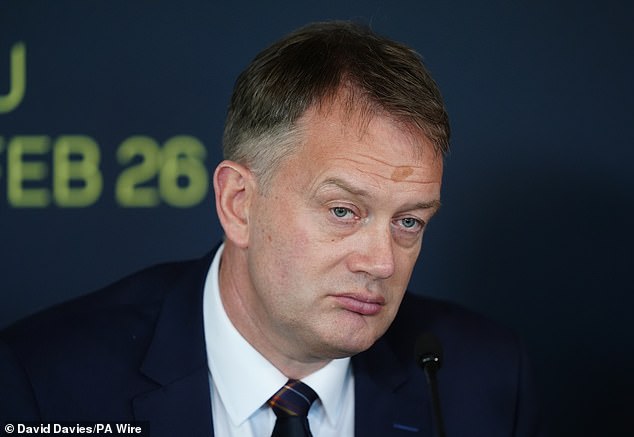
There was a lot for Scottish football to be proud of in the season which has just ended.
The national team making it back to a World Cup for the first time in 28 years. A titanic title race. Viewing figures soaring.
It’s still impossible to escape the dark episodes which pockmarked an otherwise joyful ride, though.
Pitch invasions which had a sinister edge to them. The controversies that surrounded the season finale. And, just two weeks ago, a referee and his family requiring police protection simply for making a decision which some people didn’t agree with.
‘It was disgusting,’ said SFA chief executive Ian Maxwell of the matter which stemmed from John Beaton awarding Celtic a late penalty at Fir Park.
‘Honestly, I was absolutely raging. It is fundamentally just not right.
SFA chief executive Ian Maxwell says he was left ‘raging’ over the Fir Park penalty fallout
‘Everyone has to look at every bit that makes that happen. Every bit of media commentary, whether it is a statement from a club or a manager talking after a game or a player.
‘There are a lot of bits that escalate to the point that someone says, ‘I am going to stick a referee’s details online”. How anyone thinks that is acceptable is an absolute disgrace.’
Head of the governing body since 2018, Maxwell always knew his job would be all-encompassing.
Not in a month of Sundays did he ever believe it would involve contacting the head of serious crime over concerns for the safety of one of his match officials.
‘To be fair, he (the police officer) was like, ‘we deal with this all the time, just send us his details and we will sort it, we will send officers out to see him”,’ Maxwell explained.
‘And then through William (Collum), you are speaking to John and saying, ‘Do you want to move your family into hotels, an Airbnb, or are you happy staying where you are?”
‘As a family John made the decision they wanted to stay at home, but when you are having to have those conversations at 9pm on a Thursday night … scratch that, it doesn’t matter what time of day or night it is, it is just not acceptable.
‘That’s one of those nights when you think, this isn’t what anyone signed up to.’
No one decides to become a referee because they enjoy being popular. Like players and managers, they do it because of a love of the game.

Referee John Beaton points to the spot after being urged to review footage of the late incident
After the way the season ended, and the horrific circumstances Beaton and his family found themselves in, you’re inclined to ask if any aspiring young officials might think better of it.
‘Football is fun,’ added Maxwell. ‘Everyone should enjoy it whatever your involvement is. I am incredibly lucky that I am going to fly with the team on Sunday to the World Cup.
‘But there are a lot of elements of it that are the opposite of that. One of the areas we need to focus on is recruitment and retention of referees.
‘Tell me anyone in Scotland right now who is sitting at home saying, ‘I know what I want to do, I want to be a referee”. If we don’t have any refs, we don’t have a huge amount of football.’
The previous Saturday, at the same venue, Hearts felt hard done by as they drew with Motherwell. Alexandros Kyziridis believed he should have had a penalty when Tawanda Maswanhise stood on his foot. Referee Steven McLean watched the incident on his pitch-side monitor and wasn’t convinced.
When Sam Nicholson challenged Auston Trusty four days later, Beaton concurred with VAR Andrew Dallas’ view that a handball offence had occurred.
Amid the nuclear fall-out, something became accepted as a matter of fact; That both decisions would have been different if Scottish football’s version of VAR was fit for purpose. It’s a suggestion Maxwell simply doesn’t accept.

Motherwell’s Sam Nicholson was adjudged to have handled the ball as he tried to head clear
‘There is a narrative that we have VAR-lite and it’s a cheap VAR system,’ he added. ‘But we have the same VAR system as over 50 per cent of European nations.
‘We have a six-camera system because that’s what we’ve got from a production point of view in the Premiership.
‘Do I think more cameras would help? Yes. But do I think it’s the solution to the problem? No.’
New Rangers chief executive Jim Gillespie believes throwing more money at VAR — including some from the SFA’s World Cup booty — would help improve matters. Maxwell isn’t totally convinced.
‘The World Cup profit is one thing and we’ll use that to develop and grow the game,’ he stressed. ‘But there are other things we can do. We’ve had discussions with clubs about improving it and that’s for them to determine.
‘Having match officials run out on to the pitch under as little pressure as possible will do more to improve decision making than spending more money on cameras.
‘VAR is working. It’s eradicating errors. But, unfortunately, we have a culture within Scottish football that just wants to focus on the negative and over-analyse and forensically analyse every decision that’s ever made.’
Given the fact that VAR will never settle every argument, Maxwell feels it’s imperative that everyone involved is mindful of their language.

Maxwell has doubled down on the future of VAR and insists the technology is here to stay
‘We’re fine with criticism,’ he insisted. ‘But when it crosses over into allegations of bias and corruption or being disrespectful to our staff and officials, a line has been crossed and I need to say enough is enough.’
Those who would like to see VAR put in the bin are set to be disappointed.
‘It won’t happen,’ Maxwell stated. ‘Why would it happen? Everyone gets starry-eyed about the pre-VAR days. Why would we want to go back to a situation where we get more decisions wrong? It makes no sense.’
VAR wasn’t the issue when Rangers and Celtic clashed in the quarter-final of the Scottish Cup in March at Ibrox. It was supporters from both sides who evidently saw nothing wrong with entering the field of play.
Seen across the world, the scenes at full-time were shameful. The findings of the independent review which the SFA commissioned should be made public in the next fortnight. Regardless of what comes out from it, Maxwell knows it was no isolated incident.
From amateur cup finals to Old Firm clashes, pitch invasions have become increasingly prevalent and it’s a trend that can no longer continue.
Warning that we cannot have ‘another season of mayhem’, chief constable Jo Farrell wants to see a crackdown by clubs and regulatory bodies on such disorder.

The ugly scenes at the end of Celtic’s game with Hearts put Scottish football in a very bad light
Maxwell wholly agrees, believing the situation has now reached the point where football must play its part by imposing tougher sanctions on clubs where supporters literally cross the line.
‘We need to look at what we are doing to try and fix it,’ he said. ‘From an association perspective, crowd behaviour starts with the SPFL, obviously we work very closely with them.
‘We need to engage with clubs to understand what it looks like and I think the police can help.
‘The SPFL talked about criminalising individuals coming on the pitch, criminalising tailgating getting into stadiums and FBO (football banning order) legislation. All those would help solve the problems. But nothing alone is the panacea, nothing will fix all ills.
‘When fans are coming on to pitch, there’s often both sets of players and a set of match officials, it’s not unreasonable to think that at some point that escalates and something serious happens.
‘At that point, we’re all under real pressure. So, we need to look at ourselves now and work out what do we do to stop that happening.
‘I can understand the comments (from police) because UEFA have got a different way of dealing with things. But I think that’s a road that we’re going to have to look at as Scottish football because the only thing that impacts supporters’ behaviour is things that impact the supporters. History has proven that.’