
There was one moment when Scotland were poised to beat Brazil.
It was not the Billy Bremner miss of 1974 at 0-0 or the struggle at Hampden in 1966 which also finished in a draw. These concerned events on the pitch.
Scotland’s best chance occurred in talks off it. In June 1990, Scotland faced Brazil in the final Group C match of the World Cup.
‘There was a huge discussion in the Brazilian camp before the match over whether it would be better to lose to the Scots,’ says Tim Vickery, author and expert on South American football, particularly the Brazilian variety.
‘Brazil topping the group would put them in direct collision with Argentina and they obviously didn’t want to meet them so early. There were serious talks of taking it easy against the Scots and losing the match, so finishing second to Costa Rica in the group. But the idea was rejected.’
Brazil beat Scotland with a late goal and Costa Rica thus faced Czechoslovakia in the knockout round. Brazil did come up against Argentina, who had finished one of the best third-placed teams in the group stages.
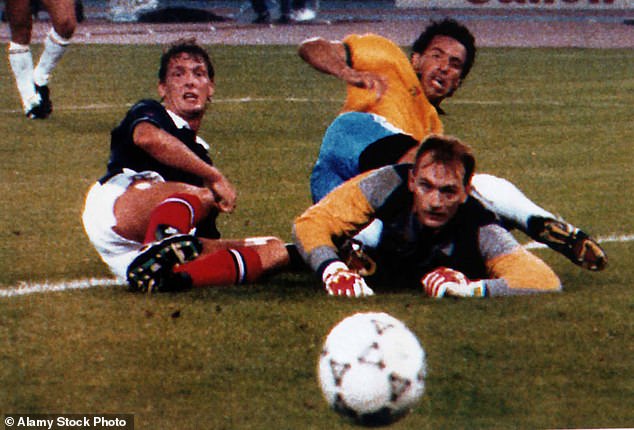
Scotland goalkeeper Jim Leighton can only watch as Brazil forward Muller’s effort creeps in
Costa Rica went out of the tournament. But so did Brazil after pummelling Argentina for most of the 90 minutes. A sliver of genius from Diego Maradona, releasing Claudio Caniggia to score, was the difference.
Scotland, unaware of the talks in the Brazilian camp, had returned home by then. They have faced the purveyors of the beautiful game four times in the World Cup. They have yet to win.
The Brazilians are not anticipating any change to this narrative in Miami on June 24.
How does Brazil view Scotland in a footballing context?
‘As irrelevant,’ says Vickery. ‘That’s cruel but it is true. There is much more respect for the Scottish tradition in Argentina.’ This is despite football being introduced to Brazil by a Scot, Thomas Donohue.
‘Brazil generally looks down its noses at other sides and Scotland are very much part of that.’
Brazil’s focus is on themselves rather than their opponents. Vickery points out that there is still a debate in Brazil, where he has lived since the mid-nineties, over the quality of the 1982 side that went out to Italy in a match for the ages.

Stuart McCall battles with Brazil’s Ricardo Gomes in a game that could have ended differently
Join the discussion
Should teams ever deliberately lose to avoid tough opponents, or does that betray the spirit of football?
‘Some say that was a great side but others point out that they beat nobody in the tournament,’ says Vickery. Brazil defeated Russia, New Zealand and Scotland. ‘That was a very good Scotland side with Dalglish, Souness, Robertson and Strachan. Yet Brazilians will insist they were nothing.’
So, what is the mood in Brazil over this World Cup? ‘It’s always manic depressive,’ says Vickery. ‘We are s***… we are unstoppable. That’s the polarity. There is a saying that to win the World Cup Brazil has to be first booed by their own supporters.’ The first match, a draw against Morocco, has attracted criticism and no little apprehension.
There is, though, calmness at the top. Carlo Ancelotti, who has experienced extraordinary success as a player and a manager, has adapted to his head coach role in Brazil with customary dexterity.
‘Ancelotti is a great fit. He is not an ideologue. He can’t be seen as Johnny Coloniser arriving to impose his way,’ says Vickery. ‘He hasn’t. His system is the same as his predecessor. He is pragmatic. He has said to himself: “How can I work with what I have got”.’
Ancelotti, too, at 67, is energised by the challenge. ‘He is absolutely loving it. He is getting off on how much the players want to play for their international side. For a lot of Europeans it is a drag to go on international duty but not for Brazilians. They play in Europe but international breaks give them the chance to speak their own language, tell their own jokes, sing their own songs.’

Brazil walk out for their clash with Diego Maradona’s Argentina in the last 16, a match they lost
He adds: ‘For all the problems of nationalism — and it is a force I struggle with — there is a purity in South America about who you are representing. You are not representing a billionaire who has bought the club as a toy or the investment fund of a nation state. The players love that. Marcello, the wonderful full-back for Real Madrid, once said he would trade all his Champions Leagues for one World Cup.
‘Richarlison did not make the squad but his passion for the national team was obvious. He said in training every day he dreamed of playing Argentina in a World Cup final. He blamed part of his most recent depression on Brazil being knocked out of the World Cup in Qatar.’
The Brazilian line-up is cavalier. ‘Ancelotti knows he is in a job where winning the World Cup is success and anything else is failure,’ says Vickery. ‘He has to capitalise on the squad’s strengths and that is a complement of excellent wingers.’ The Italian has Vinicius Jr, Raphinha, Martinelli and Rodrygo.
‘He is determined to play with four up front,’ says Vickery. He notes that 4-2-4 is a ‘huge risk’, adding: ‘It is particularly so when one of the midfielders is Casemeiro who is 34.’ Indeed, Casemiro was taken off at half-time against Morocco.
Ancelotti has told his squad that ‘nobody should be thinking of a Ballon D’Or’. Vickery says: ‘Everybody will have to put a shift in in tough conditions. It’s not going to work unless that happens.’
Vickery has made the World Cup and South America his specialist subject. He writes and broadcasts from his home in Rio de Janeiro and has joined forces with Mark Biram, an academic, to write his first book.

Former Rangers and Dundee striker Claudio Caniggia celebrates his winner in Turin
Mundiales, published by Pitch, is an engrossing history of how the greatest tournament in sport has been shaped by South American teams and how the round ball has influenced the culture, politics and outlook of the continent.
Vickery is a clear-eyed debunker of many of the myths held by those in this part of the world. The idea of a samba-style indigenous to every South American country brings a sharp riposte.
‘Football is never static and there are always ideas ping-ponging around. There is always change. One of the most stereotypical ideas is the uniqueness of the Columbian side of the eighties and nineties with Carlos Valderrama. This hypnotic possession style was branded as definitively Colombian but the mother idea came from the Dutch side of the 1970s.
‘People get a little bit het up about national styles of football and, yes, there can be differences, but at the end of the day there is a score and that is the final arbiter.’
Mundiales explores all this and more. It sparkles with informed takes: why Pele may not have been chosen for the 1970 World Cup, his crowning glory, why Maradona was derided by largely white, middle-class Argentine journalists and why South Americans are justified in looking back on the 1966 World Cup as a carve-up worthy of a time-served butcher.
But its broad scope means it is an indispensable guide to the World Cup. Surprisingly, it is Vickery’s first book. ‘I never wanted to do one,’ he says. However, he was intrigued by the pairing with Biram, who holds a PhD in Hispanic studies and is now at Bilkent University in Ankara, Turkey.

Andy Roxburgh and Craig Brown look on dejectedly as Scotland’s World Cup ends early
‘I believe the overall arc is compelling,’ he adds. ‘For example, the World Cup would not have started until the 1950s without the drive from South American countries. There are fabulous stories to be investigated and brought to the wider world. It can’t just be an academic book.
‘It has to be a story people have not heard before.’
It is all that more and it is subtly underpinned by Vickery’s experience and his ability to deliver verdicts after surveying substantial evidence.
He has also identified dark horses for the tournament from South America.
‘Columbia won the South American Under-17 title recently and they are side who one day could go all the way.’
But it is not all about winning. Vickery adds: ‘If you are a Scot, then get behind Paraguay. They are just guts and team spirit. I remember the Paraguayan coach, Gustavo Alfaro, telling his players: “I want you to remember sleeping five to a bed and when your parents scrimped to buy boots for you or a bike to get you to a training session. Your dream was to play in a World Cup. Get in touch with that inner kid”.’
Paraguay, of course, have made a poor start to the tournament, thumped 4-1 by the USA, and are braced for games against Turkey and Australia. They will need more than their ‘inner kid’ to see them continue in the tournament beyond the group stage.
The outlook for Scotland contains a clash with Brazil that is filled with significance and with moments of history. It would be a time for the ages if Steve Clarke’s men became the first Scots to beat Brazil.
Mundiales, by Tim Vickery and Mark Biram, is published by Pitch