
Situated on the mouth of the Forth, Methil is not the first place which springs to mind when it comes to destinations promising a day in the sun.
Figuratively speaking, at least, that’s what supporters of Inverness Caledonian Thistle will be hoping for this weekend.
New Bayview, with its exposed single stand, is poised for an invasion of Highlanders hoping to see history made. After the most troubled period in the club’s history, the spartan surroundings are irrelevant.
Three years on from contesting the Scottish Cup final and nosediving into deep financial trouble, Inverness are on the rise again.
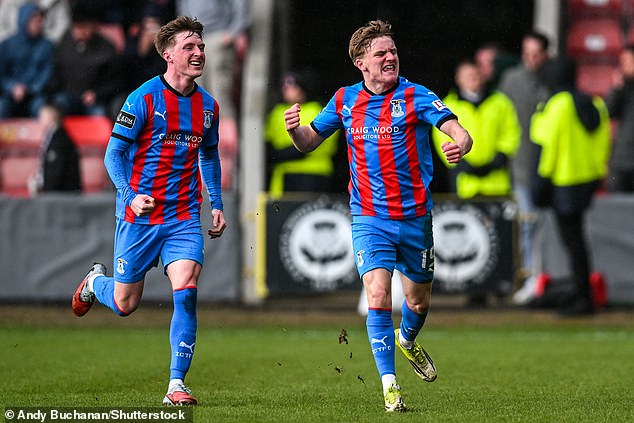
Despite starting this season with minus five points, Scott Kellacher’s side have bounded up the rails.
Unbeaten in the league since December 27 and with a free-scoring striker in Alfie Bavidge, they face Dick Campbell’s men knowing a victory will assure them of the League One title ahead Stenhousemuir with a game to spare.
Inverness have seen dark times but now stand on the brink of promotion from League One
A two-year stay in the third tier of Scottish football is nearing an end. The storm clouds which threatened the club’s very existence are being blown away.
Might Inverness follow the lead of Falkirk and bounce back to the Premiership in two strides? We shall only know in time.
Recalibrated as a progressive and financially stable community club, that’s certainly the intention. For now, though, the club’s long-suffering supporters are just relieved to be reawakening from a fevered nightmare.
‘We were in such a bad place both on and off the pitch that the club was fractured,’ and Stevie Riley of The Wyness Shuffle podcast.
The threat of insolvency had hung in the air long before it hit them between the eyes two years ago. Relegated from the top flight in 2017 after a seven-year stay, it seemed like the board believed the worst could never happen.
Still paying many players Premiership-level wages, Inverness posted hefty losses every year they were in the Championship.
In season 2021-22, they were £835,000 in the red — £600,000 more than was lost the previous financial year.
A auditors note from that time revealed there were assets of £462,000 and liabilities of £1,715,000 — a financial situation which left ‘a material uncertainty that may cast significant doubt on the company’s ability to continue as a going concern’.

The club’s loyal fan base have stuck behind their team amid their on and off-field struggles
In that regard, the money generated from the run to the following year’s cup final was merely delaying the inevitable.
A club which had strategically plotted its way up the divisions and into Europe across 30 years had become a financial basket case.
Super Caley were no longer going ballistic. When the full picture was laid bare by the administrator, they were in serious danger of going out of business.
There was a growing air of desperation on the banks of the Moray Firth. Despite leading the team to Hampden, Billy Dodds was sacked after a poor start to 2023-24.
His replacement, Duncan Ferguson, was box office yet there was little to suggest he possessed any managerial credentials.
Inverness finished ninth and were relegated via the play-offs. For the first time this century, they were facing life in the third tier.
Much worse was to follow. In a desperate bid to cut costs, the club announced it had agreed a partnership with Kelty Hearts which would see the training base moved 135 miles south to Fife.
Predictably, the proposal caused outrage among fans and former players alike. Former winger Daniel Mackay described it as ‘ludicrous’ and ‘appalling’.

Just three years ago, Inverness were playing against Celtic in the Scottish Cup final
In the face of vehement criticism, the plan was eventually ditched but the reputational damage was considerable.
It wasn’t the first time the board — led by CEO Scot Gardener — had tried something left-field to bring in revenue.
First there was The Caley Thistle Concert Company. Andrea Bocelli and Duran Duran did play on summer’s nights in 2022, but there were reports of chaotic organisation and the company was eventually liquidated.
Then came an attempt to create a battery storage scheme — earmarked for a piece of land close to Fairways Business Park. After initially being approved by Highland Council, this was rejected.
It later emerged that the land around the Caledonian Stadium was not going to be included in the ‘green freeport zone’ — thus denying companies considering locating there tax and customs incentives.
The club also missed out on a park-and-ride deal which could have been worth up to £1.7million, a matter which saw chairman Ross Morrison resign.
With none of these schemes coming off, the club began to run of fumes. At the start of last season, a crowdfunder — ‘Save ICT’ — was launched seeking £200,000 to keep the wolf from the door. Interim chairman Panos Thomas revealed that £1.6m would be needed to last the season.
By that stage, Gardiner was no more — ousted when former chairman Alan Savage returned and pumped in £200,000 in emergency funding. His last act had been to bring a potential buyer in Ketan Makwana’s Seventy7 Ventures to the table. Negotiations were suspended after questions were raised regarding the buyer’s credibility.

Duncan Ferguson had a brief spell in charge at the Caledonian Stadium until the club hit trouble
On Gardiner’s five-year watch, a club with an annual revenue of between £2m-£2.25m had accrued costs of £3.7m. With no rabbit coming out of the hat, administration was always coming.
The club was automatically deducted 15 points by the SPFL in the October and found itself bottom of the league on minus three points.
Ferguson was sacked later that month, but head coach Kellacher somehow secured the safety of seventh place. This act of escapology was played out against a background of doom.
Last March, administrators BDO said a deadline to find a new owner had passed, leaving the club facing the prospect of potential liquidation. Buyers had raised concerns including how loans of £3.5m would be paid off and the need to reach deals with other shareholders.
But, over following months, deals were reached to exit administration and Savage, a local man who’d made good money in recruitment, took full control.
‘He’s an astute businessman, very, very popular in the local area,’ Riley explained.
‘The first thing was getting us fixed off the pitch, getting a relationship back with local sponsors and businesses because that was fractured as well.
‘If you don’t have your local sort of friends within the area to invest in the club, then you’re not going to go far.’

Current boss Scott Kellacher has worked wonders to lead the club towards the Championship
Like Savage, Kellacher — a former goalkeeper who was once on the books of Celtic — is another local man steeped in what the club means to its community. They’ve worked tirelessly in tandem to build Inverness back up.
‘I think what Scott’s done is managed us both on and off the pitch,’ added Riley. ‘He’s brought the club back together. It’s back to being a community club which a club of our size and stature should be.’
For a club which has known no little success in 32 years, trips to Methil are reminders of the game’s fickle fates. But as Ross County may soon discover as another relegation looms, a ticket to the top of the Scottish game offers no guarantee of remaining there.
‘I’m sure the boys in the pub on Saturday will give me grief,’ said Riley. ‘But I wouldn’t mind them staying up so we get the derby back. It’s good for the area.’