
- Unlock more of the best of our journalism with a DailyMail+ subscription – brilliant exclusives, in-depth insight and the writers you love every day
The protocol is written in plain and simple language on the website of football’s official lawmakers. In fact, it’s so clear that some of it is actually written in bold type.
‘A video assistant referee may assist the referee only in the event of a “clear and obvious error” or “serious missed incident“,’ is the way it reads on the IFAB portal.
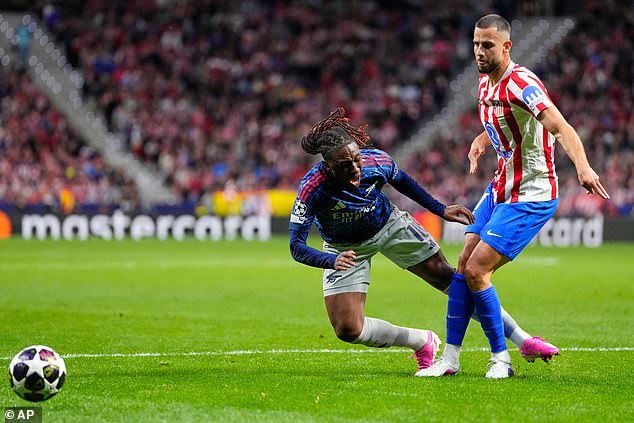
So that’s the first reason Arsenal can have to feel robbed after last night’s draw with Atletico Madrid in the Champions League. The call by match referee Danny Makkelie to award a penalty after a tussle between Eberechi Eze and David Hancko with 10 minutes left was a tight one and should have been left well alone by his VAR colleague Dennis Higler. It was impossible to prove either way. There are arguments for and against.
This is what motivated Arsenal manager Mikel Arteta to call the decision to overrule ‘completely unacceptable’ and from that point of view he is absolutely right. This is not the only problem here, though. No, this is a shambles that has two roots.
The first involves the application of clear protocol, the following of pretty simple rules. Why can’t VAR officials do this? Why can’t they keep their hand off the red button unless it’s really necessary? Only they will really know.
The second is more nuanced and complex and wrapped up in human nature, peer pressure and hierarchy. It’s harder to identify and definitely more difficult to solve. But it’s just as real.
Once referee Danny Makkelie had given a penalty for a foul on Eberechi Eze, IFAB rules state he could only overturn the decision if it was a clear and obvious error

Makkelie instead heeded the advice of his Dutch compatriot Dennis Higler and overturned his own on-field decision
The suspicion, voiced regularly by those close to them, is that match referees in the Premier League and across Europe are simply scared to go against the whims, wishes and interventions of their VAR colleagues. They tend therefore to take the easier route – the one suggested to them by the freezing of an image on a screen – perhaps in pursuit of a quieter life.
In Madrid last night, Makkelie – a terrific, experienced and well-regarded referee who has officiated at two European Championships and a World Cup – was working with a VAR he knows well, his Dutch compatriot Higler. They were also in tandem when Arsenal hosted and beat Bayer Leverkusen in March.
It’s common for groups of match officials to regularly work together across the Champions League. It’s not obligatory but it happens a lot. And sources tell Daily Mail Sport that pressures naturally build within that group to ‘stick together’.
For example, Italian match referee Maurizio Mariani is known to feel conflicted about changing his decision to give Liverpool a penalty for a foul on Alexis Mac Allister against PSG at Anfield earlier this month.
Once VAR official Marco Di Bello asked his compatriot to go to the touchline screen, Mariani followed the familiar route of reversing his initial call. He admitted privately afterwards that the pressure he felt to do so had been significant.
‘This is the way it works,’ a source close to the refereeing community says. ‘These guys all know each other. They work together all the time. The referees just don’t want to go against the VAR guys.
‘It’s almost like rebellion if they do. It just makes everyone feel uncomfortable. So with the world watching, they stick together. It’s human nature.’
That call at Anfield was huge. Liverpool were two goals down from the first leg but dominating the second game. A goal then could have changed the whole tie.

Italian match referee Maurizio Mariani is known to feel conflicted about changing his decision to give Liverpool a penalty for a foul on Alexis Mac Allister against PSG at Anfield this month

And in Tuesday’s semi-final first leg, referee Sandro Scharer gave a penalty against Bayern Munich for a perceived handball by Alphonso Davies – despite not giving it when he saw it live
Similarly, last night’s intervention feels crucial and is sadly familiar to what we see regularly in the Premier League, an environment in which a referee’s decision to stick with his original call is so rare that it is celebrated wildly by all of us – and there are many – who never wanted cameras involved with football in the first place.
There is no point returning to that debate here. VAR is part of the game’s fabric now. But steps must be taken to break up the hierarchy and free match officials of the pressure they appear to feel not to rock the boat, not to go against the wishes of the men sitting in cabins watching monitors in some remote corner of London or, in UEFA’s case, Switzerland.
Football matches are supposed to be refereed by the person standing on the grass with the whistle. We are drifting ever further from that and should all feel deeply embarrassed by it.
Match officials are honest and in the game for the right reason. Equally, the external forces being placed upon them by a system that is supposed to make their life easier is clearly becoming too great.