
Ange Postecoglou called it an oncoming train. Thomas Frank thought Tottenham were cursed. Igor Tudor dismissed such notions of black magic as ‘bulls**t’ but wasn’t around long enough to uncover the truth while Roberto De Zerbi is learning fast.
Just three games into the job and Spurs’ latest man in charge has already lost Cristian Romero, Mohammed Kudus, Dominic Solanke and Xavi Simons to injury and all for the rest of the campaign.
Welcome to Tottenham. And so continues one of the longest, most brutal injury crises in recent Premier League memory, more than 300 games missed and counting, and one that could play its part in sending Spurs down.
Data from Premier Injuries shows that since the start of the last season, no side has suffered more injuries nor seen their players missing for a longer period of time than beleaguered Spurs.
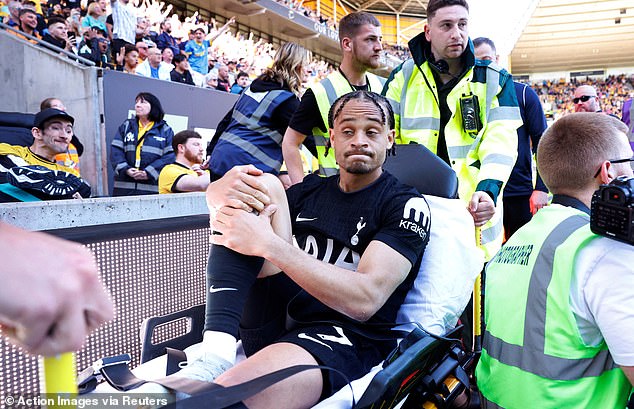
Tottenham’s injured players this term alone have missed SEVEN MONTHS of action more than any other team. That number will only continue to grow after Solanke pulled his hamstring and Simons ruptured his ACL at Molineux to take Spurs’ injuries up to 37 for the campaign. They have collected more ACL injuries than home wins this season.
And those figures, which run from the opening weekend, don’t even include those carried over from the summer which included knee injuries to James Maddison, Radu Dragusin, Dejan Kulusevski and Destiny Udogie.
Tottenham’s Xavi Simons is carried off the pitch at Molineux after rupturing his ACL

Tottenham’s Dejan Kulusevski has not kicked a competitive ball in nearly a year
Kulusevski has not kicked a competitive ball in nearly a year. Neither has Maddison. Solanke was sidelined for 19 league games earlier in the season with an ankle injury and now he’s going to miss the final four. Midfielders Yves Bissouma and Rodrigo Bentancur have missed 30 between them.
All clubs get injuries but Spurs’ plight has been something to behold. They have averaged more than seven senior players unavailable every week over the course of the Premier League season. The league average is about 3.5.
Tottenham have been diabolical and cannot hide behind their missing players but is it too much of a jump to imagine they might have found two more points with those attacking talents at their disposal?
West Ham, by contrast, have suffered the fewest injuries of any side. Tottenham’s injured bunch have missed a combined two years and eight months more than those of the Hammers. That has to make a difference.
How on earth has it come to this? Tottenham supporters will often point back to that infamous game against Chelsea in Postecoglou’s first season – the one with the ridiculously high line – as the moment when the curse was cast with Micky van de Ven pulling his hamstring while chasing back and Maddison going off with an ankle injury.
It became such an issue that Spurs conducted an internal review at the end of Postecoglou’s first season that led to a complete overhaul of the backroom team and the departure of Geoff Scott as the club’s head of medicine and sports science after more than 20 years at the club.
Still the style didn’t change and the injuries racked up. Only Brighton suffered more last season. Opta analysis during the 2024-25 season showed that Tottenham led the way for sprints, pressures in the final third, off the ball runs out of possession. Hamstrings made up nearly 60 per cent of Tottenham’s muscle-related injuries. The Premier League average was around 40 per cent.
Yet here they are still, even without Angeball. Everything has changed – four managers in 12 months, chairman Daniel Levy gone, his friends gone, more turnover of backroom staff – and yet nothing has changed either.

Simons was coming into form for Spurs before his injury and will now not be able to help the fight against relegation

Mohammed Kudus is also out for the season having picked up an injury in January
‘We could field a starting XI of injured players that might even be stronger than the XI that’s currently playing,’ said full back Pedro Porro back in March. ‘It’s not out of disrespect to anyone, but that’s basically the reality.’
So, questions get asked of the medical department. In March last year, Romero posted on Instagram to say he was ‘grateful to the physios at Argentina for pulling me out of a bad moment and getting me back on the field where I’m so happy’ after returning following three months out in what appeared a snub towards those of his club.
Spurs don’t help themselves either. Postecoglou said Kulusevski was ‘just a knock’ after his injury against Crystal Palace. He had surgery on his patella days later and hasn’t kicked a ball since. Frank said in December that Solanke was ‘progressing forward’ with his recovery. He missed another five games. De Zerbi described the striker’s issue after the Wolves win as ‘not a big problem’. He’s out for the rest of the season. It all fuels the speculation as to who, if anyone, has the club’s fate under control.
Things have got so bad that fans are now wondering: could it be… the pitch?
The Tottenham Hotspur Stadium is the only ground in the Premier League home to a retractable surface, where three interlocking grass trays are wheeled in and out to allow NFL matches to be played on synthetic turf below it.
It was on that pitch underneath that Buffalo Bills star linebacker Matt Milano suffered an ACL injury following a player pile-up and after which one unnamed Bills player reportedly remarked: ‘We came all the way over to London to play on f***ing cement?’ Team-mate Taron Johnson: ‘The turf was terrible here. They have to get rid of it – report that’.
Theories have begun to grow, too, about the Spurs surface because Real Madrid, another team with a retractable pitch, are enduring an injury crisis of their own.
Arizona Cardinals suffered the most injuries in last season’s NFL and guess what their State Farm Stadium has? Yep, a retractable pitch leading their local news website Azcentral to wonder… ‘is it the field?’
‘It raises lots of questions about the design and the implications for the performance of the pitch,’ Steph Forrester, Professor of Sports Engineering and Biomechanics at Loughborough University, tells Daily Mail Sport. ‘I wouldn’t necessarily expect it to behave like an actual grass pitch because it has got such a different design to it and the implications for that in terms of both hardness and grip are quite interesting.’
It’s easy to get swept away, though, when searching for answers. Of the 10 current Tottenham injuries, only half of them were suffered at the Tottenham Hotspur Stadium. Where were the crises in their first few seasons there?

James Maddison goes down with an ACL injury on Tottenham’s pre-season tour

The midfielder has only just returned to the Tottenham bench – but has yet to make it on to the pitch
All pitches have to pass a FIFA standard for things like firmness, grip and bounce. Like all Premier League pitches, the turf at the Tottenham Hotspur Stadium is a hybrid one: made up of natural turf with a small percentage of artificial grass to make it more durable and consistent. Club ground staff make their own checks throughout the season.
‘Fundamentally, normal hybrid pitches and retractable ones are the exact same,’ Greg Whately, principal technical consultant at STRI, formerly the Sports Turf Research Institute, tells Daily Mail Sport.
STRI last year joined forces with the Premier League to launch the Pitch Standards Framework and regularly tests pitches to make sure they’re up to scratch.
‘You still have the 300mm of root depth as in normal pitches. It could be slightly shallower, it could be 250mm, but the majority we have worked on are still that 300mm depth. Performance wise, they should perform exactly the same. How the grass grows, the surface hardness, there shouldn’t be any difference if they are designed and maintained correctly.
‘The critical thing is the joins. That is the area that has the potential to be the weakest part of it. That is the area they will have spent most time on to make sure there’s no discrepancies. I would find it highly unlikely that it is the pitch. I know the standards they have to produce and the testing they do. It shouldn’t be a factor.’
For some, it’s not just the retractable ones. ‘Modern pitches are a disgrace,’ posted former striker Stan Collymore on X in response to questions over whether Spurs’ crisis is down to the turf.
‘Add the disgrace that are modern boots and the impacting in joints, bones and tendons is the equivalent of jolting on concrete. Original pitches had soft earth under grass allowing checking, turning and impacts to be absorbed. Player welfare sacrificed at the altar of all-season optics.’
Artificial fibres do make hybrid surfaces harder. ‘They tend to be the hardest of the surfaces and have quite a high traction (grip) as well,’ adds Forrester, who specialises in the impact of artificial pitches. ‘It is very difficult to isolate the pitches as a main factor because there are just so many potential ones when it comes down to injuries.’

There have been some suggestions that Tottenham’s retractable pitch – it has an NFL pitch beneath it – has been responsible for some of the injuries

Tottenham’s Brazilian striker Richarlison pulls up with an injury

Spurs captain Cristian Romero can only watch from the stands due to injury
The Isokinetic Football Medicine Conference in Athens earlier this month reported a study that showed there was little difference in overall injuries between natural grass, artificial and hybrid turf, though there was a slight trend towards a higher proportion of non-contact injuries on hybrid turf.
For Spurs, however, the constant chopping and changing in the dugout hasn’t helped.
‘The things that would stick out to me would be the different types of managers in the way that they play and train in a very short period of time, coupled together with the calendar of a professional footballer,’ Mark Leather, former head physiotherapist at Liverpool and Sunderland, tells Daily Mail Sport.
‘If you’ve had four managers in just over one season, those players won’t know what the hell’s happened to them. Different managers that play with a different intensity, a different tactical philosophy, suddenly different stresses are being put upon them. That is probably one of the major factors.’
Ben Dinnery of Premier Injuries adds: ‘You also cannot overlook historical injuries as one of the best indicator of future injury burden. Destiny Udogie, his problems keep cropping up. There are definitely elements of that. If you look at players who missed large parts of pre-season, they will go into the season with a greater risk of picking up more injuries. Solanke ticks that box.’
Or, maybe, they’re just cursed.