
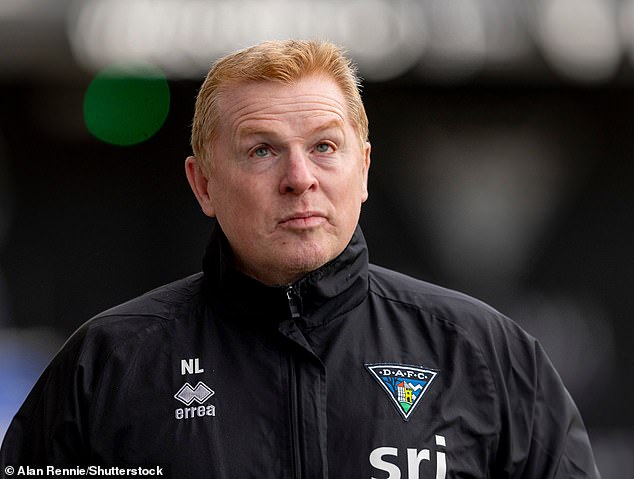
At the start of last season, Neil Lennon found himself at a crossroads in his career.
A left field move to Romania to manage Rapid Bucharest had ended abruptly after four months and six winless matches.
On the back of a more successful eight months with Cypriot side Omonia, his wandering days appeared to be over.
He’d already managed Celtic twice either side of leading Hibs back to the Premiership. Having ventured across the border, Bolton Wanderers had offered a tough schooling in the difficulty of leading a club in financial free fall. So, where to next?
Given his managerial CV encompassed a dozen honours and a slaying of Barcelona, from a distance, a posting at Dunfermline might have seemed curious.
Yet, historically, there was a trail of breadcrumbs which led the Northern Irishman to the door of East End Park.
Neil Lennon’s appointment at Dunfermline took many by surprise but things are going well
The first of his three Celtic goals had arrived there in March 2001. Three of his cup winner’s medals in green and white had come in finals against the Pars.
The last of those, the 2007 Scottish Cup final, proved to be his final appearance as a Celtic player before he moved to Nottingham Forest.
East End Park also has a hospitality suite named after one Jock Stein — the man who lifted the Scottish Cup in Fife in 1961. No explanation required.
It’s easy to believe that Lennon’s brushes with Dunfermline in his playing days would have played some part in his somewhat surprising decision to move there.
Under Jimmy Calderwood, the club were mainstays of the top division, making it into Europe twice and finishing as high as fourth in 2004. Back then, their ground was frequently filled to capacity.
But a loose connection with a club and an appreciation of what it once was aren’t, in themselves, reasons to sign on the dotted line.
Lennon was sold on Dunfermline’s long-term plan. He’ll believe a trip to Hampden to face Falkirk is only the first sign that it’s coming together.

Lennon won three cup finals for Celtic against the Pars, including the Scottish Cup in 2007
After a slow start on Halbeath Road, a man who achieved legendary status in Glasgow’s East End is now relishing life in the ground which goes by the same name.
For his youthful side, promotion via the play-offs is a distinct possibility but this joust with John McGlynn’s side is a gilt-edged opportunity to create history.
Dunfermline have already taken care of Hibernian and Aberdeen in this run. What price a third Premiership scalp?
For the supporters who will make the trip across the Kincardine Bridge in their numbers, the occasion will be a reminder of both the way things used to be and how savage the intervening years have been.
By the time that 2007 final had come around, the club’s seven-year stay in the top division was already coming to an end.
The Pars spent four years in the second tier. The optimism when they returned to the top flight at the first time of asking under Jim McIntyre was short-lived.
Jim Jefferies, who took charge in the March 2012, was unable to keep the side from bubbling under but much worse was to follow.

Lennon has guided the Pars to fourth in the Championship and the Scottish Cup semi-finals
Dunfermline entered administration in April 2013 and were relegated to the third tier for the first time since 1986. There was a real fear the club could fold.
Jefferies was unable to dig them out of a hole. Promotion was also beyond the capability of John Potter.
With matters more settled off the park, Allan Johnston won the League One title in 2016. Yet those who believed the great recovery was finally underway would be guilty of wishful thinking.
The club spent a further six years in the Championship but only finished inside the top four twice.
Four years ago, the nightmare recurred. A season which began with Peter Grant at the helm concluded with John Hughes failing to see off upwardly mobile Queen’s Park in the relegation play-off.
This was not how it was supposed to be when DAFC Fussball GmbH — a German consortium – arrived on the scene in 2020 to purchase a minority stake with the promise of building the club up through a data-driven structure.

Just like he did as a player, Lennon continues to enjoy ‘giving it back’ to critics in the stands
Although James McPake took the side back up to the Championship in 2023, there was a lack of investment in the first team and no indication that the mooted full takeover of the club was ever going to happen.
Few tears were shed when the consortium put their 30 per cent stake up for sale in 2024.
Fortunately for Dunfermline fans, the appeal of their club’s untapped potential had reached across the Atlantic.
Although born in England, James Bord had built his reputation and his considerable wealth in Las Vegas. As a professional poker player, he once won $1,313,611 on a single event.
But it was the workings of his company, Short Circuit venture, which first captured the imagination of long-suffering Pars fans — and ultimately persuaded Lennon to go all-in.
Bord previously worked for Tony Bloom — he of Brighton and Hearts fame — plus Brentford’s Matthew Benham. These associations sparked an interest in bringing the field of data analytics to football.
He formed Short Circuit in 2016 with its website revealing that it employs ‘state-of-the-art AI algorithms to conduct comprehensive player analysis’. Sound familiar?
In a rare interview, Bord, who also has stakes in Bulgarian second-tier outfit Septemvri Sofia and Cordoba in Spain’s La Liga 2, explained why he and business partner Evan Sofer felt Dunfermline was a hand-in-glove fit for their strategy.

Entrepreneur and former professional poker player James Bord is co-owner of the Fife club
‘We were looking for an outlet to develop young players,’ he said. ‘We have three clubs and we don’t want to bite off more than we can chew.
‘A step-by-step approach is much healthier, as creating stress hurts performance. We are focusing on Dunfermline.’
On what he discovered when he first set foot in the Kingdom, Bord added: ‘I wouldn’t say it was soulless, but it was lost as a club.
‘I bought Dunfermline because I love the underdog. The ambition is to bring back some of their history, but also to change the atmosphere at the club.
‘They are a very passionate fanbase that has suffered enough pain, and we’d like to bring them some joy.’
The early appointment of Michael Tisder demonstrated that the computer isn’t always right.
Lennon’s remit after being appointed until the end of last season was to keep Dunfermline afloat.
Having succeeded in that goal, a two-year contract was agreed. That happens to be the timeframe in which Bord believes Dunfermline can return to the Premiership.
‘A big personality can steer the ship back in the right direction,’ Bord added. ‘Neil’s presence at the club makes everyone’s day around the place.
‘His front-foot playing style suits my philosophy and hopefully we have him now for another two years.’
Lennon is on board with all that Short Circuit offers, but feels there’s still scope for traditional scouting methods to strengthen the squad and take the club where it wants to go.

Lennon took on Manchester United and Erik ten Hag in the Europa League with Omonia Nicosia

The look may have changed but the burning will-to-win is still evident in the Northern Irishman
‘We recommend players, they recommend players,’ he explained. ‘We come to an agreement. It’s not one competing against the other. It’s for the benefit of the club going forward.’
While the acquisitions of Alfons Amade, Nurudeen Abdulai and Shea Kearney have provided a quick vindication of the data-led approach, the steady improvement in results seen throughout the season owes as much to the growing influence of Jeremiah Chilokoa-Mullen and Matty Tod. This is the product of training ground toil.
Tod scored and ran riot as Aberdeen were hammered 3-0 in the quarter-final.
It remains to be seen if Dunfermline can make the quantum leap back to the Premiership after a 19-year absence or make it back to a Hampden final after the same hiatus.
But after years of suffering, they now seem to be in the right hands. They finally have a plan. It’s conceivable that the right man to execute it was hidden in plain sight for so long.